
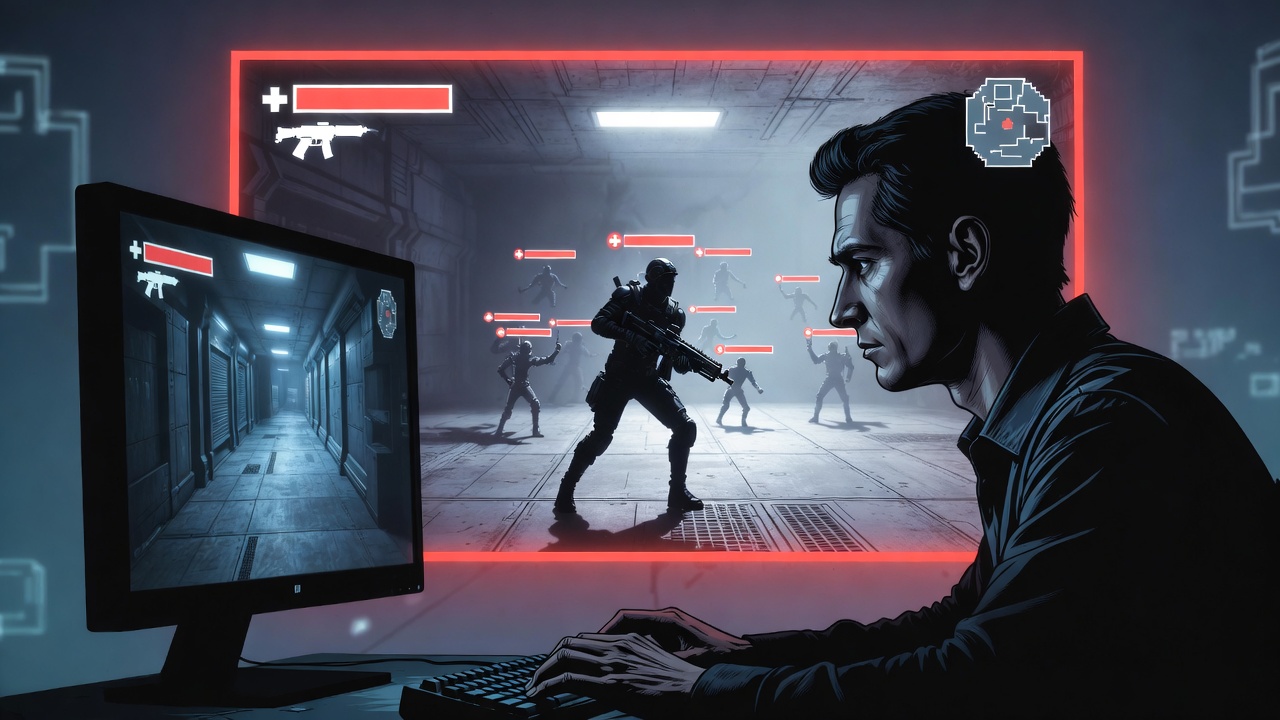
Smarter Enemy AI Without Cheating
In modern game development, enemy AI often walks a narrow line between providing meaningful challenge and frustrating players through unfair advantages. Traditional approaches frequently rely on “cheating” mechanics—giving enemies perfect knowledge of player positions, infinite reaction times, or hidden stat boosts—to simulate intelligence. As AI technologies mature in 2026, studios can move beyond these shortcuts toward smarter enemy AI without cheating, creating opponents that feel skilled, adaptive, and fair while relying on perception, decision-making, and learning systems grounded in realistic constraints.
Smarter enemy AI without cheating shifts the paradigm from scripted or omniscient behaviors to systems that operate under the same informational and physical limitations as the player. This approach not only increases immersion but also enables emergent difficulty curves, replayability through varied responses, and opportunities for players to outthink opponents rather than outlast artificial advantages.
Why Traditional Enemy AI Relies on Cheating
Most games in the past decade have used one or more of these common cheats to keep enemies threatening:
- Perfect information: Enemies always know where the player is, even through walls or across vast distances.
- Reaction times beyond human limits: Instant aiming, dodging, or countering with zero latency.
- Hidden buffs: Increased damage, health, or accuracy when the player performs well.
- Scripted sequences: Pre-determined actions that ignore player state or environment changes.
These techniques solve short-term difficulty spikes but create noticeable inconsistencies. Players quickly detect patterns—enemies that “know too much” break suspension of disbelief, especially in stealth, tactical shooters, or open-world titles.
Perception-Driven AI: The Foundation of Fair Challenge
Smarter enemy AI without cheating begins with limited, realistic perception models. Enemies process the world through simulated senses rather than direct access to game state.
Key components include:
- Field of view (FOV) cones extended with realistic falloff for peripheral detection
- Hearing simulation based on sound propagation, occlusion, and distance attenuation
- Memory decay for last-known positions, with uncertainty increasing over time
- Communication between agents to share partial information (e.g., one guard alerts others)
Tools like Unity’s NavMesh combined with custom perception graphs or Unreal Engine’s Behavior Trees with blackboard systems make this feasible. More advanced setups integrate ML-based perception filters (e.g., lightweight vision models trained to approximate human-like attention).
Example: In a tactical shooter, an enemy squad hears distant gunfire but must investigate cautiously, using cover and flanking paths derived from pathfinding rather than teleporting. If the player breaks line of sight, the last-known position fades, forcing enemies to search methodically.
Decision-Making Layers Without Omniscience
Once perception is constrained, decision-making must handle uncertainty intelligently.
Modern approaches layer behaviors:
- Reactive layer — Immediate responses to visible threats (dodge, shoot, take cover)
- Tactical layer — Squad coordination, flanking, suppression fire
- Strategic layer — Long-term goals like defending objectives or hunting the player
Reinforcement learning (RL) variants, such as self-play trained agents (inspired by DeepMind’s work on AlphaStar or OpenAI’s Dota 2 agents), allow enemies to discover effective tactics within defined rules. These agents learn from millions of simulated matches without explicit programming for every scenario.
Practical integration often uses imitation learning on top of RL: record human-designed expert behaviors, then fine-tune with self-play to add variation and robustness.
Machine Learning for Adaptive Difficulty
To avoid static difficulty, smarter enemy AI without cheating leverages online learning or offline-trained models that adapt per session or across a player base.
- Player modeling: Track player habits (aggression, preferred weapons, movement patterns) and adjust enemy priorities accordingly.
- Curriculum learning: Start with simpler behaviors and gradually introduce complexity as the player improves.
- Ensemble agents: Run multiple lightweight ML policies and select the most appropriate based on context.
Real-world example: Games like F.E.A.R. (2005) used goal-oriented action planning; today, titles experiment with ML agents in prototypes (e.g., Unity ML-Agents toolkit demos show enemies learning parkour or team tactics without cheats).
Strengths and Limitations in Practice
| Aspect | Strengths of Smarter AI Without Cheating | Limitations & Trade-offs |
|---|---|---|
| Immersion | Feels organic; players can exploit mistakes | Requires more tuning to avoid “dumb” moments |
| Development Cost | Reusable across titles once trained | High initial training compute and iteration time |
| Replayability | Emergent strategies from imperfect knowledge | Risk of exploits or unintended easy wins |
| Performance | Constrained perception reduces CPU load vs. full omniscience | ML inference adds overhead (mitigated by edge devices) |
| Fairness Perception | Players respect losses more when opponents play “fair” | Harder to guarantee consistent difficulty spikes |
Data from studios using ML-Agents shows 20–40% reduction in manual behavior scripting time after initial setup, though debugging emergent failures remains challenging.
Realistic Use Cases in Current and Near-Future Games
- Stealth games: Guards with realistic patrols, suspicion buildup, and dynamic searches (e.g., inspired by Metal Gear or Dishonored but with ML-varied routines).
- Tactical shooters: Squads that flank, suppress, and coordinate without wall-hacks.
- Boss encounters: Multi-phase bosses that learn player patterns mid-fight (e.g., adjusting to dodging habits) without stat inflation.
- Open-world survival: Predatory creatures that stalk based on scent trails and environmental cues.
Tools supporting this include:
- Unity ML-Agents (for training and deployment)
- Unreal’s Learning Agents plugin
- Custom PyTorch/TensorFlow integrations via Barracuda or ONNX
External resources for deeper exploration:
- DeepMind’s work on multi-agent RL in games
- Unity ML-Agents documentation and examples
- GDC talks on perception systems in modern AI (search for “AI perception” or “behavior trees”)
- Research paper: “Grandmaster level in StarCraft II using multi-agent reinforcement learning” (Nature, 2019)
For related discussions on 24-Players.com, see:
- AI Tools That Actually Save Time in Game Development
- AI-Driven Game Pipelines: From Idea to Playable Build
- Can AI Make Games More Human?
- Using AI to Predict Player Drop-Off
FAQ
Q: Does smarter AI without cheating make games easier? A: Not necessarily. It trades artificial difficulty for organic challenge. Skilled players can exploit imperfections, but average players often find matches more satisfying because wins feel earned.
Q: How much compute is needed to train these systems? A: Offline training can require GPU clusters (weeks for complex agents), but inference runs efficiently on consumer hardware. Many studios use pre-trained base models and fine-tune locally.
Q: Can small teams implement this today? A: Yes, with tools like Unity ML-Agents or Godot add-ons. Start simple (perception + basic RL) and scale complexity iteratively.
Q: Will players notice the difference? A: In blind tests, many report higher engagement and less frustration compared to cheat-based AI, especially in repeated playthroughs.
Q: What about cheating for spectacle (e.g., dramatic boss moments)? A: Targeted, transparent cheats for narrative beats remain valid. The goal is to minimize them for core gameplay loops.
Key Takeaways
- Smarter enemy AI without cheating relies on constrained perception, layered decision-making, and ML-driven adaptation rather than hidden advantages.
- Perception and memory systems create believable opponents that players can outmaneuver.
- ML techniques (RL, imitation learning) enable emergent behaviors with reduced manual scripting.
- Trade-offs exist in tuning, performance, and consistency, but the payoff is greater immersion and fairness.
- Current tools make this accessible even for mid-sized teams, pointing toward widespread adoption in the next few years.
As game worlds grow larger and more interactive, smarter enemy AI without cheating represents a critical step toward living, responsive systems. The future lies in opponents that learn, adapt, and challenge players on equal terms—transforming frustration into respect and turning every encounter into a genuine test of skill and strategy. This evolution not only elevates gameplay but sets the stage for truly dynamic, player-driven narratives in persistent sci-fi universes.
Leave a Reply