
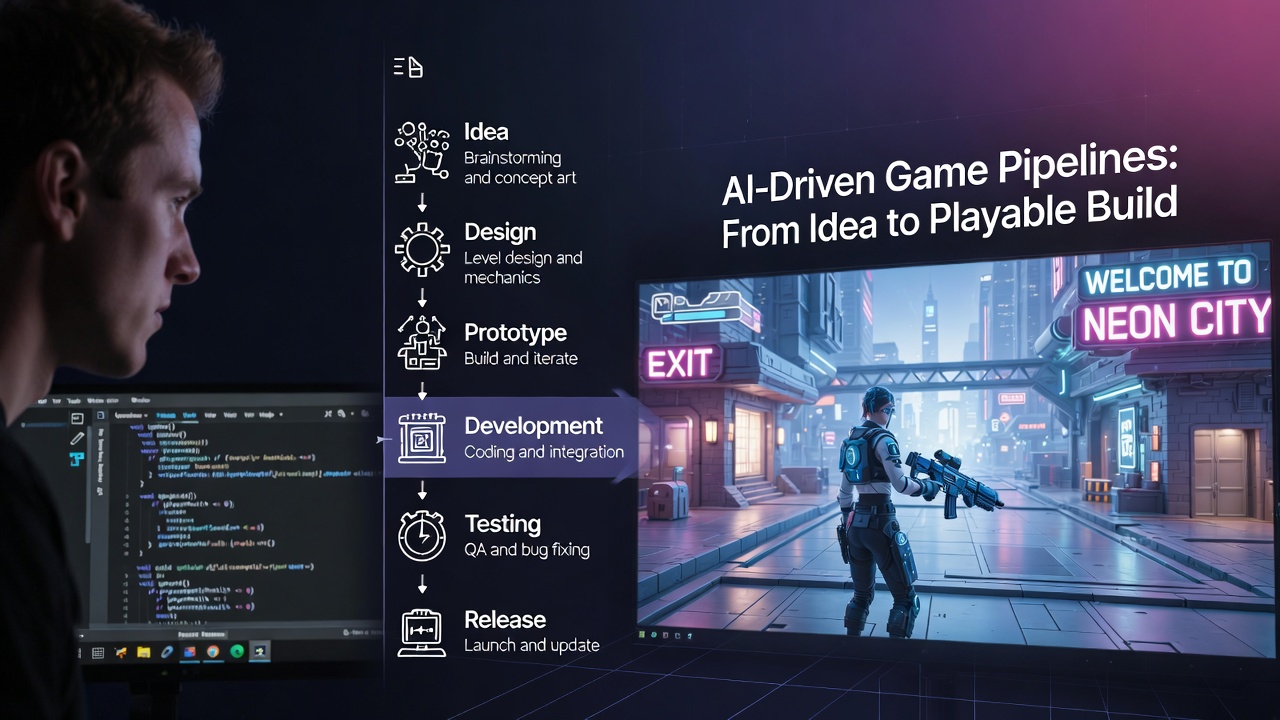
AI-Driven Game Pipelines: From Idea to Playable Build
AI-Driven Game Pipelines: From Idea to Playable Build represent one of the most transformative shifts in modern game development. In 2026, studios no longer treat AI as an isolated feature for asset generation or NPC behavior. Instead, integrated AI systems span the entire production lifecycle, compressing timelines from concept to playable prototype while maintaining—or even enhancing—creative control.
This approach moves beyond ad-hoc tool usage toward structured, end-to-end pipelines where AI handles repetitive, data-heavy, or exploratory tasks at every stage. The result is faster iteration, reduced risk in early validation, and more resources allocated to high-level design and polish.
Why Traditional Pipelines Struggle in 2026
Conventional game development pipelines follow a largely linear or waterfall-inspired model: concept → pre-production → production → testing → launch. Each phase involves manual handoffs, artist iterations, and engineer implementation, often leading to bottlenecks.
Key challenges include:
- Concept to prototype lag — Turning a game idea into something testable can take weeks or months.
- Asset volume requirements — Open-world or live-service games demand thousands of variants.
- Iteration cost — Changes late in production multiply expenses across disciplines.
- Uncertainty in fun factor — Early builds rarely capture core loops accurately.
AI-Driven Game Pipelines: From Idea to Playable Build address these by injecting automation, prediction, and generative capabilities throughout.
Core Stages of an AI-Driven Pipeline
1. Ideation and Concept Phase
AI accelerates brainstorming and validation without replacing human vision.
- Prompt-based concept generation — Tools like Midjourney, Stable Diffusion variants, or specialized platforms (e.g., Ludus AI) produce visual mood boards, character designs, and environment sketches from text prompts refined by art directors.
- Narrative scaffolding — Large language models outline lore, quest structures, or dialogue trees based on high-level premises.
- Feasibility checks — Early ML models estimate scope (e.g., polygon budgets, performance implications) using historical project data.
Example: A studio inputs “cyberpunk city with vertical slums and neon hover traffic” and receives dozens of coherent variations in minutes, allowing rapid down-selection.
2. Pre-Production: Greyboxing to Vertical Slice
This phase traditionally relies on manual placeholder art. AI-Driven Game Pipelines: From Idea to Playable Build introduce procedural and generative shortcuts.
- AI greyboxing — Tools generate basic level layouts from sketches or text (e.g., “multi-level arena with chokepoints and verticality”). Tripo3D or similar convert 2D concepts to rough 3D meshes.
- Procedural placeholder assets — Houdini + ML plugins or Unity’s Sentis create modular environment pieces with variation.
- Core loop prototyping — Reinforcement learning agents play simple rule-based versions of the game to identify balance issues or drop-off points before human testing.
Practical case: In a multiplayer shooter prototype, AI generates map variants, populates them with basic bots, and runs thousands of simulated matches to highlight problematic sightlines or spawn points.
3. Production: Asset Creation and Integration
Here, AI scales volume while preserving style.
- Texture and material automation — Substance 3D + AI upscalers or generators produce PBR materials matching reference art.
- Animation retargeting and blending — Motion diffusion models (e.g., based on recent research from Meta or NVIDIA) create locomotion cycles from limited mocap data.
- Code generation for systems — GitHub Copilot-style tools or game-specific LLMs draft shaders, behavior trees, or UI logic.
Limitations remain: AI outputs often require human cleanup for edge cases, seamlessness, and brand consistency.
4. Testing and Iteration
AI shifts QA from reactive to predictive.
- Automated playtesting — Bots trained on player data simulate diverse behaviors, uncovering exploits or balance problems.
- Visual regression detection — Computer vision compares builds for unintended changes.
- Performance profiling — ML predicts frame-time spikes in new levels.
Example Pipeline Comparison Table
| Stage | Traditional Timeline | AI-Augmented Timeline | Key AI Tools/Techniques | Primary Benefit |
|---|---|---|---|---|
| Concept → Moodboard | 2–4 weeks | 2–5 days | Text-to-image (Ludus, Flux variants) | Rapid visual exploration |
| Greybox Level | 3–6 weeks | 1–2 weeks | Procedural gen + Tripo3D | Faster spatial validation |
| Core Loop Prototype | 2–4 months | 4–8 weeks | RL agents, simple sims | Early fun factor assessment |
| Asset Production | 6–12 months | 3–6 months | Generative textures, animation models | Volume scaling with style control |
| Playtesting Pass | Manual, iterative | Hybrid automated | Behavioral ML bots, CV regression | Earlier, broader issue detection |
(Note: Timelines vary by project scope; figures represent approximate averages from 2025–2026 industry reports.)
Realistic Tools in 2026
- Ludus AI — Strong pipeline integration via plugins and APIs for Unity/Unreal.
- Tripo / Meshy — Fast 2D-to-3D conversion for placeholders.
- Unity Sentis / Unreal ML Deformer — On-device inference for procedural content.
- Custom fine-tuned models — Studios train small LLMs on internal codebases for scripting assistance.
- Reinforcement learning frameworks (e.g., Stable-Baselines3 integrations) — For agent-based testing.
Strengths: Speed, scale, consistency in grunt work. Limitations: Lack of true novelty without heavy curation; occasional “AI artifacts” in visuals or logic; high initial setup cost for custom training.
FAQ
Q: Does AI-Driven Game Pipelines: From Idea to Playable Build eliminate the need for human designers? A: No. AI excels at variation and acceleration but lacks intentionality, taste, and holistic vision. Humans define direction, curate outputs, and make final calls.
Q: What’s the biggest risk in adopting this approach? A: Over-reliance on early AI prototypes that feel “good enough,” leading to sunk-cost fallacies when fundamental flaws emerge later.
Q: How much faster can a studio realistically ship? A: 30–50% reduction in pre-production and early production phases is common in 2026 case studies, though full titles still take 1–3 years depending on scope.
Q: Are these pipelines only for large studios? A: No—indie teams benefit disproportionately due to limited resources, often using cloud-based tools with low upfront cost.
Q: How do you maintain artistic consistency across AI-generated assets? A: Fine-tune models on studio-specific datasets, use ControlNet-style guidance, and enforce style references in prompts.
Key Takeaways
- AI-Driven Game Pipelines: From Idea to Playable Build compress timelines by automating exploration, variation, and validation.
- The biggest gains occur in pre-production and prototyping, where uncertainty is highest.
- Success depends on treating AI as infrastructure, not magic—integration, training, and human oversight are essential.
- Tools like Ludus, Tripo, and ML testing frameworks are mature enough in 2026 for production use.
- The approach preserves creativity by freeing time for what humans do best: defining experience and meaning.
For related reading, explore AI Tools That Actually Save Time in Game Development, Building an AI Tool Stack for Modern Game Development, Ludus AI: What It Gets Right for Game Dev Pipelines, and Automating Level Design Without Killing Creativity (forthcoming).
External references:
- NVIDIA’s work on generative game assets
- Unity Sentis documentation
- GDC 2025 talks on AI pipelines
- Research on RL in game prototyping (example placeholder for recent papers)
- Tripo3D capabilities overview
In the coming years, AI-Driven Game Pipelines: From Idea to Playable Build will become standard for studios aiming to ship ambitious titles with constrained resources. The studios that thrive will be those that build intentional systems around AI—not to replace creativity, but to amplify it at every step toward the playable experience. The future belongs to pipelines that learn, adapt, and scale alongside the teams that design them.
Leave a Reply