
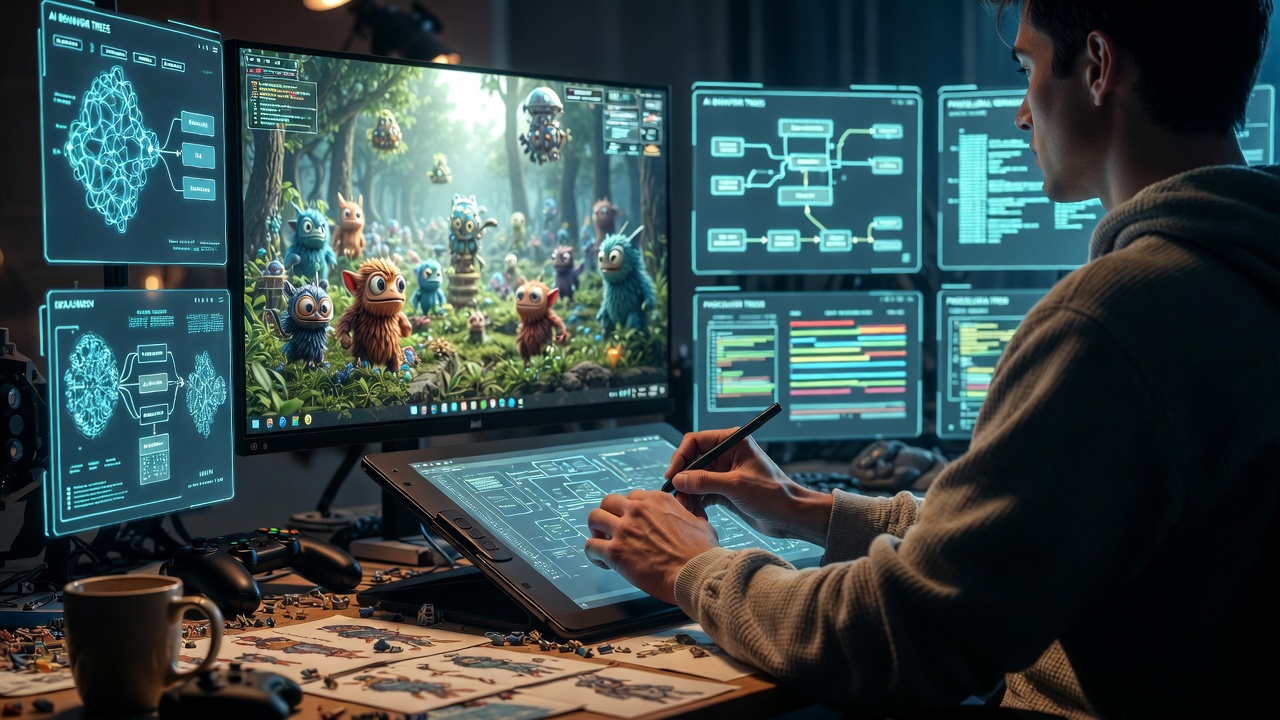
How AI Changes Pre-Production for Games
How AI Changes Pre-Production for Games marks one of the most immediate and practical shifts in modern game development workflows. Pre-production—encompassing concepting, prototyping, vertical slices, and planning—traditionally consumes 12–24 months in mid-to-large projects, often bottlenecked by iteration loops, asset placeholders, and alignment across disciplines. In 2026, AI systems integrated into these early stages compress timelines, expand exploration, and alter decision-making without eliminating human direction.
Studios adopting AI-native approaches report 30–60% faster pre-production phases in targeted areas like concept iteration and blockout validation. This does not mean “instant games,” but rather a rebalancing of effort toward higher-fidelity early decisions and broader creative range-finding.
Why Pre-Production Remains Critical in an AI Era
Pre-production defines the project’s DNA: core loop viability, art direction feasibility, technical constraints, and scope realism. Even with advanced generative tools, poor choices here cascade into costly mid-production rework.
AI changes this phase by accelerating feedback loops and enabling parallel exploration at scales previously impossible.
- Rapid concept variation reduces reliance on single art briefs
- AI-assisted prototyping surfaces mechanical flaws earlier
- Data-driven scope estimation replaces gut-feel scheduling
Yet AI introduces new risks: overconfidence in early outputs, style drift across tools, and the need for robust validation layers.
Accelerating Concept and Ideation
Traditional concept art pipelines involve mood boards, iterative sketches, and multiple artists converging on direction. How AI Changes Pre-Production for Games becomes evident in tools like Midjourney, Stable Diffusion variants fine-tuned on studio IP, or newer game-specific models (e.g., Ludus AI or similar pipeline-oriented generators).
Strengths include:
- Generating dozens of variations from a single text+reference prompt in minutes
- Style transfer across 2D to 3D (e.g., image-to-3D via Tripo or Meshy)
- Consistent character/ environment libraries built from seed images
Limitations persist:
- Lack of narrative coherence without heavy prompting or post-editing
- Artifacts requiring cleanup (anatomy errors, lighting mismatches)
- Risk of “generic” outputs unless grounded in custom LoRAs or ControlNet
Practical example: A studio defining a cyber-noir open world might generate 200 cityscape variations, cluster them via CLIP embeddings, and select clusters for mood bible refinement. This shifts weeks of manual iteration into days, allowing designers to focus on thematic coherence rather than initial volume.
AI in Early Prototyping and Greybox Validation
Prototyping traditionally uses greybox assets to test mechanics before art lock. How AI Changes Pre-Production for Games here involves procedural blockout tools and ML-driven layout suggestions.
Tools like Houdini with ML nodes, or emerging Unreal/Unity plugins (e.g., generative level blockouts via diffusion models or reinforcement-learned placement), allow designers to input high-level parameters (“dense urban combat zone with verticality”) and receive multiple layout candidates.
Realistic use case:
- Input: Gameplay archetype + reference images + navmesh constraints
- Output: 10–20 blockout variants with basic navmesh, cover placement, and sightlines scored by simple heuristics (accessibility, chokepoint density)
This enables rapid A/B testing of spatial designs. One studio developing a extraction shooter used AI blockouts to identify that player-reported “fun” correlated with 25–35% open sightlines—data used to guide manual refinement.
Limitations:
- AI layouts often favor optimization metrics over feel
- Requires human override for intentional friction or surprise
Technical and Scope Validation in Pre-Production
AI aids in early technical due diligence and scope estimation.
- Performance simulation: ML proxies predict draw calls, shader cost, or physics load from blockout geometry
- Asset budget forecasting: Vision-language models analyze concept art to estimate poly count, texture sets, and animation needs
- Risk classification: NLP tools scan design docs to flag ambiguous mechanics or high-uncertainty systems
Example table of AI impact on pre-production deliverables:
| Deliverable | Traditional Time | AI-Assisted Time | Key AI Contribution | Remaining Human Role |
|---|---|---|---|---|
| Concept Art Set | 4–8 weeks | 1–3 weeks | High-volume variation & style tests | Curation, narrative alignment, cleanup |
| Vertical Slice Blockout | 6–10 weeks | 3–6 weeks | Procedural layouts & variants | Mechanic tuning, feel iteration |
| Scope Document | 3–5 weeks | 1–2 weeks | Auto-risk flagging & estimation | Validation, prioritization |
| Technical Feasibility | 4–6 weeks | 2–4 weeks | Proxy simulations & profiling | Final profiling & engine tweaks |
These estimates draw from 2025–2026 case studies shared at GDC and developer surveys.
Integrating AI Without Losing Creative Control
Successful studios treat AI as a parallel ideation engine rather than a final arbiter.
Best practices:
- Maintain human-defined style guides and negative prompts
- Use iterative refinement loops (generate → critique → regenerate)
- Version control AI seeds and prompts alongside assets
- Run blind playtests on AI vs manual prototypes to measure bias
External reference: NVIDIA’s developer resources on AI in early game pipelines highlight similar hybrid workflows, while Unity’s ML-Agents documentation shows prototyping acceleration.
For related reading on 24-Players.com, explore AI Tools That Actually Save Time in Game Development for tool selection, Building an AI Tool Stack for Modern Game Development for integration patterns, or Ludus AI: What It Gets Right for Game Dev Pipelines for pipeline examples. Additional insights appear in The Hidden Costs of AI Tools in Game Production.
FAQ
Q: Does AI make pre-production so fast that full production shrinks dramatically? A: Not automatically. While pre-production compresses, production often expands to match higher early fidelity and ambition. Net savings appear in reduced rework, not always shorter total cycles.
Q: Can small teams skip traditional pre-production with AI? A: Partially. AI enables solo or tiny teams to explore scope previously requiring larger staffs, but discipline in culling ideas remains essential to avoid feature creep.
Q: Are AI-generated concepts legally safer for pre-production? A: Early concepts using public models carry risks if trained on copyrighted data. Studios increasingly use licensed or self-hosted models for IP-sensitive work.
Q: How do you prevent AI from homogenizing game aesthetics? A: Heavy customization via fine-tuning, ControlNet, IP-specific datasets, and strict human curation gates.
Q: What metrics track AI effectiveness in pre-production? A: Iteration velocity (concepts/week), prototype validation speed, percentage of ideas reaching vertical slice, and post-pre-production change orders.
Key Takeaways
- How AI Changes Pre-Production for Games centers on volume, variation, and early validation rather than replacement of human judgment.
- Core gains appear in ideation speed, layout exploration, and risk identification.
- Limitations include artifact cleanup, coherence challenges, and risk of over-optimization.
- Hybrid workflows—AI for breadth, humans for depth—yield the strongest outcomes.
- Studios that master prompt engineering, tool chaining, and validation loops gain meaningful advantages in 2026 and beyond.
Pre-production remains the foundation of game quality. As AI tools mature, the phase evolves from slow convergence to rapid divergence and focused convergence. The studios that thrive will use AI to ask better questions earlier, not to shortcut answers. The result is not faster games alone, but higher-confidence projects built on broader, more rigorously tested foundations—setting the stage for production phases that scale without collapsing under their own ambition.
How AI Changes Pre-Production for Games
Leave a Reply