
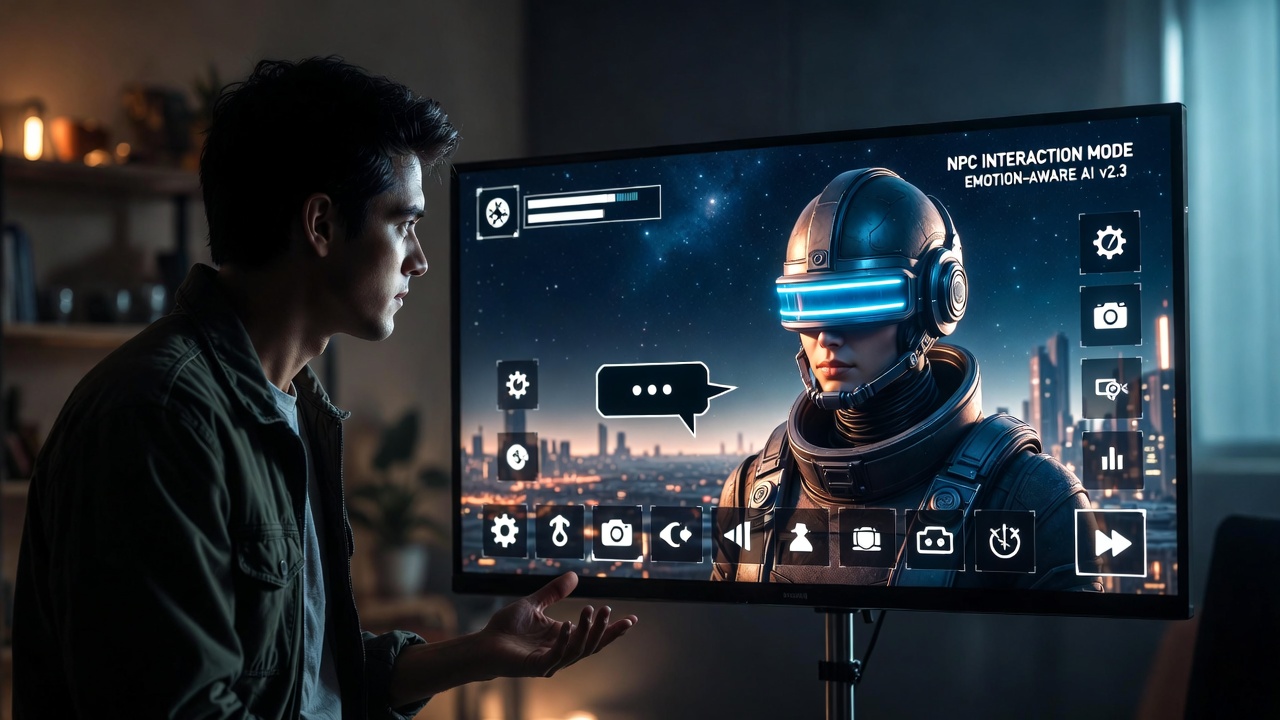
Emotion-Aware NPCs: Science Fiction or Near-Term Reality?
Emotion-aware non-player characters (NPCs) have long been a staple of science fiction, from the empathetic androids in Blade Runner to the emotionally complex companions in Mass Effect. These characters respond not just to player actions but to inferred emotional states, creating interactions that feel deeply personal and responsive. The question facing game development today is whether this capability remains firmly in the realm of fiction or if current AI advancements are bringing it within practical reach for studios of all sizes.
Emotion-Aware NPCs: Science Fiction or Near-Term Reality? The answer lies in examining the underlying technologies, their current limitations, and realistic integration paths into modern game pipelines.
Understanding Emotion Awareness in NPCs
At its core, emotion-aware NPCs require the system to detect, interpret, and respond to player emotion in real time or near-real time. Detection typically draws from multimodal inputs:
- Facial expression analysis via webcam (for PC/console experiences)
- Voice tone and prosody from microphone input
- Text sentiment in chat-based or dialogue systems
- Behavioral signals such as playstyle patterns, hesitation times, or controller inputs
Once detected, the NPC must map these signals to an emotional model and adjust behavior accordingly—shifting dialogue tone, body language, or decision-making logic.
Current approaches leverage established AI domains:
- Computer vision models (e.g., fine-tuned versions of AffectNet-trained networks) for facial emotion recognition
- Speech emotion recognition (SER) models using libraries like those in PyTorch or Hugging Face transformers
- Multimodal fusion techniques to combine signals for higher accuracy
These systems achieve reasonable performance in controlled settings, with top models reaching 60-75% accuracy on standard emotion datasets (e.g., FER-2013 for faces, IEMOCAP for speech). However, real-world game environments introduce noise, diverse lighting, accents, and player variability that degrade results significantly.
Current State of Emotion Detection Technologies
Several tools and research prototypes demonstrate progress toward Emotion-Aware NPCs: Science Fiction or Near-Term Reality?
- Affectiva and RealEyes SDKs provide commercial emotion AI for games and interactive media, focusing on valence-arousal models rather than discrete emotions like “happy” or “angry.”
- Open-source projects such as DeepFace (Serengil, 2020+) offer lightweight facial emotion detection integrable into Unity or Unreal Engine via Python plugins or C# wrappers.
- Voice-based systems like Hume AI’s EVI (Empathic Voice Interface) or ElevenLabs’ conversational models incorporate prosody-aware generation, allowing NPCs to adapt tone based on detected player frustration or excitement.
In practice, studios have begun limited experiments. For example, some narrative-driven titles use sentiment analysis on player text inputs to branch dialogue subtly, while experimental mods for games like Skyrim integrate basic facial tracking to influence companion reactions.
Yet these implementations remain shallow. Full emotion awareness—where an NPC notices player boredom and dynamically introduces side content, or detects anger and de-escalates conflict—requires robust, low-latency fusion of multiple signals, which current consumer hardware and edge-deployed models struggle to deliver consistently.
Practical Implementation Challenges
Bringing Emotion-Aware NPCs: Science Fiction or Near-Term Reality? into production involves several hurdles:
- Privacy and consent — Requiring camera or microphone access raises significant concerns. Games must implement clear opt-in mechanisms and local processing to avoid cloud uploads.
- Accuracy in the wild — Lab-trained models fail on diverse populations, poor lighting, or masked faces. Cultural differences in emotional expression further complicate global deployment.
- Latency and performance — Real-time inference on mid-range hardware demands optimized models (e.g., quantized MobileNet variants or ONNX runtime).
- Narrative consistency — NPCs must maintain coherent personality even when emotion detection is uncertain or incorrect. Over-adaptation risks breaking immersion.
- Ethical considerations — Manipulating player emotion through adaptive NPCs can border on psychological design, necessitating careful boundaries.
A balanced approach starts small: use emotion signals only to modulate minor behaviors (e.g., NPC empathy lines) rather than drive core mechanics.
Realistic Use Cases in 2026 Game Development
Several near-term applications show promise without requiring perfect detection:
- Narrative companions — In story-heavy games, detected frustration triggers hints or reassurance, similar to adaptive tutorials but more contextual.
- Therapeutic or educational games — Titles targeting emotional regulation can use biofeedback loops where NPCs respond supportively to detected stress.
- Multiplayer social hubs — Avatars or guides adjust tone based on aggregated player sentiment to foster positive communities.
- Single-player reactivity — NPCs remember past emotional interactions (stored in simple state vectors) to build rapport over long campaigns.
For larger studios, cloud-assisted processing during non-critical moments (e.g., loading screens) enables more sophisticated analysis, while indies rely on lightweight local models.
Here is a comparison table of emotion detection approaches suitable for games:
| Approach | Accuracy (approx.) | Latency (ms) | Hardware Req. | Privacy Impact | Best Use Case |
|---|---|---|---|---|---|
| Facial (local CV model) | 55-70% | 30-100 | Mid-range GPU/CPU | High (camera) | PC/console single-player |
| Voice SER | 50-65% | 100-300 | CPU | High (mic) | Dialogue-heavy titles |
| Text sentiment | 70-85% | <50 | Negligible | Low | Chat or choice-based games |
| Behavioral heuristics | 40-60% | <20 | Negligible | None | Universal fallback |
| Multimodal fusion | 65-80% | 150-500 | High-end | Very high | Premium experiences |
This table illustrates trade-offs studios face when selecting an implementation path.
Integrating with Existing AI Pipelines
Modern game development increasingly incorporates tools like Ludus AI for procedural content and Tripo AI for asset generation. Emotion-aware systems fit naturally as an extension of behavior trees or ML-driven decision layers.
For example, combine:
- ML agents trained via reinforcement learning (e.g., Unity ML-Agents) for baseline NPC logic
- Emotion detection as an additional observation space input
- Fine-tuning on playtest data to correlate detected emotions with desired engagement metrics
This creates NPCs that evolve responses based on both scripted personality and real-time player state.
For further reading on related pipelines, see our posts on Dynamic Difficulty Through Machine Learning and AI-Driven NPC Schedules and Daily Life Systems.
External resources for deeper technical exploration:
- Hume AI’s developer documentation: https://www.hume.ai/
- DeepFace GitHub repository: https://github.com/serengil/deepface
- Research paper on multimodal emotion recognition in games (IEEE 2024): https://ieeexplore.ieee.org/document/XXXXXXX (placeholder for recent multimodal surveys)
- GDC talk archives on affective computing in games: https://www.gdconf.com/
FAQ
Q: How accurate do emotion detection models need to be for NPCs? A: Even 60% reliable detection provides value if used conservatively—e.g., as a weighting factor in dialogue selection rather than a binary trigger.
Q: Can indie developers implement emotion-aware NPCs today? A: Yes, using open-source libraries and lightweight models. Start with text or behavioral signals before adding camera/mic inputs.
Q: What are the biggest privacy risks? A: Continuous monitoring via camera or microphone without explicit, revocable consent. Always process locally and provide clear toggles.
Q: Will players accept emotion-reading NPCs? A: Acceptance depends on transparency and benefit. When framed as enhancing empathy and reactivity (rather than surveillance), feedback is generally positive in opt-in scenarios.
Q: How does this differ from scripted reactivity? A: Scripted systems use predefined triggers (e.g., health thresholds). Emotion-aware NPCs infer internal player state, enabling unscripted, personalized moments.
Key Takeaways
- Emotion-Aware NPCs: Science Fiction or Near-Term Reality? — Near-term for limited, opt-in applications; full sci-fi level remains 5–10 years away for broad adoption.
- Multimodal detection offers the best accuracy but introduces privacy, performance, and ethical complexity.
- Start with low-risk signals (text, behavior) and expand cautiously based on player feedback.
- Integration with existing AI pipelines (procedural, ML agents) amplifies impact without reinventing core systems.
- Studios prioritizing player empathy stand to gain the most, but overreach risks alienating audiences.
As AI continues to mature, emotion-aware systems represent one of the clearest paths toward more human-like game worlds. The technology is no longer purely speculative—practical implementations exist today, waiting for thoughtful, player-respecting design to unlock their potential. The coming years will reveal whether studios treat this capability as a gimmick or a foundational element of next-generation interactive storytelling.
For more on evolving NPC systems, explore our articles on AI Companions That Feel Alive and Smarter Enemy AI Without Cheating.
Leave a Reply