
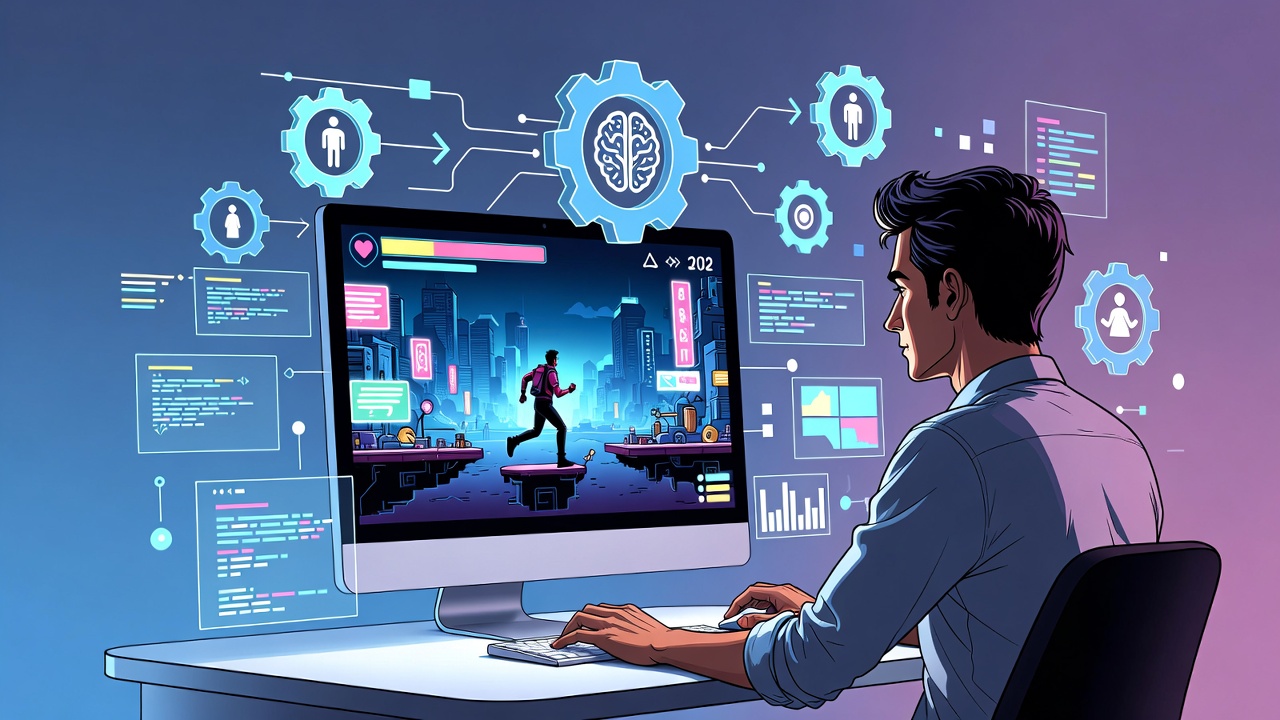
Designing Games That Learn From Players in Real Time
In the evolving landscape of game development, systems that adapt based on player input have shifted from novelty to expectation. Designing games that learn from players in real time represents one of the most promising applications of machine learning in interactive entertainment. These systems observe behavior during play sessions, adjust mechanics accordingly, and create experiences that feel uniquely tailored without requiring manual designer intervention at runtime.
Designing games that learn from players in real time means building feedback loops where the game itself becomes a responsive entity. Rather than relying solely on predefined difficulty curves or scripted events, developers can implement models that update parameters based on live data streams from player actions. This approach moves beyond traditional adaptive difficulty toward deeper personalization of gameplay loops, narrative pacing, and even world state.
Why Real-Time Learning Matters in Modern Games
Player expectations have grown with exposure to data-driven services in other domains. Games that fail to evolve with the player risk feeling static or unfair. Real-time learning addresses this by enabling systems to:
- Detect patterns in player skill acquisition
- Identify frustration points through metrics like repeated deaths or menu exits
- Recognize preferred playstyles (aggressive, stealth, exploratory)
- Adjust content generation to sustain engagement
The core advantage lies in scalability: a single model can serve millions of players while providing individualized experiences. This is particularly valuable in live-service titles or persistent worlds where long-term retention depends on continuous relevance.
Core Techniques for Implementing Real-Time Learning
Several machine learning approaches suit real-time player adaptation:
- Reinforcement Learning (RL) Agents RL models treat the game as an environment and the player as part of the state space. The agent learns optimal policy adjustments by maximizing a reward function tied to engagement metrics (session length, progression rate). For example, an RL system might tune enemy spawn rates to keep player win probability near 60%, a common target for perceived fairness.
- Contextual Bandits Simpler than full RL, contextual bandits select from discrete options (e.g., difficulty presets, item drop tables) based on player context. They balance exploration (trying new configurations) and exploitation (sticking with proven ones). This method powers many recommendation-style adaptations in games.
- Supervised Learning on Telemetry Data Models predict player churn or satisfaction from features like input frequency, death locations, or resource usage. Predictions feed into rule-based or parametric adjustments during play.
- Clustering and Embedding Models Player behavior embeddings group similar playstyles. The game then loads archetype-specific tuning parameters or spawns content variants aligned with the cluster.
Practical Examples in Current and Emerging Games
Real-world implementations demonstrate both potential and constraints:
- Dynamic enemy behavior in titles using ML-driven combat (e.g., systems inspired by AlphaStar-style training but scaled down for consumer hardware) allows opponents to mimic learned player tactics.
- Procedural quest systems that reroute objectives based on detected player interests, such as prioritizing exploration if metrics show high map coverage.
- In multiplayer contexts, matchmaking augmented with real-time skill estimation refines lobby composition beyond Elo ratings.
Tools like Ludus AI facilitate prototyping these systems by providing pre-built pipelines for behavior logging and model inference. Tripo AI, while primarily asset-focused, integrates with procedural pipelines where generated environments adapt to player navigation patterns.
Strengths and Limitations of Real-Time Learning Systems
Strengths
- High personalization at scale
- Continuous improvement without patches
- Data-driven balancing that evolves with meta shifts
Limitations
- Compute requirements for online inference can strain client devices or servers.
- Risk of overfitting to noisy early data, leading to poor adaptations.
- Explainability challenges: players may perceive changes as bugs rather than intelligent responses.
- Privacy concerns around extensive telemetry collection.
A balanced implementation combines real-time learning with guardrails: fallback static rules, capped adjustment ranges, and human-vetted reward functions.
Comparison of Adaptation Approaches
| Approach | Latency | Personalization Depth | Compute Cost | Explainability | Best Use Case |
|---|---|---|---|---|---|
| Static Curves | None | Low | Minimal | High | Short single-player campaigns |
| Rule-Based Triggers | Low | Medium | Low | High | Classic adaptive difficulty |
| Contextual Bandits | Medium | High | Medium | Medium | Live-service content rotation |
| Full RL Agents | High | Very High | High | Low | Complex simulation games |
| Embedding + Clustering | Medium | High | Medium | Medium | Archetype-driven experiences |
This table highlights trade-offs studios face when selecting an adaptation strategy.
Integrating Real-Time Learning Into Development Pipelines
Successful integration starts early:
- Define key telemetry events during pre-production.
- Build offline simulation environments to train models before live deployment.
- Use A/B testing frameworks to validate adaptations safely.
- Monitor for unintended behaviors with anomaly detection.
Tools such as procedural systems from Ludus or asset pipelines enhanced by Tripo can feed into learning loops, where generated content variants are selected based on real-time player feedback.
For related reading on asset integration, see our posts on AI-Generated Assets Trends and procedural techniques.
External resources provide deeper technical grounding:
- Google’s DeepMind on RL in games
- Unity ML-Agents documentation
- GDC talks archive on adaptive systems
- Research paper: “Player Modeling in Games” (Yannakakis & Togelius, 2018)
FAQ
Q: How much data is needed to start real-time learning? A: Initial models can train on thousands of sessions, but quality improves with tens or hundreds of thousands. Bootstrapping with simulated players helps.
Q: Does real-time learning require constant internet? A: Not necessarily. Edge inference on device works for single-player; hybrid models sync aggregates to servers for global improvements.
Q: Can players “game” the learning system? A: Yes, adversarial behavior is possible. Mitigation includes noise injection, reward shaping, and periodic model resets.
Q: Is this only for live-service games? A: No. Offline single-player titles benefit from session-based adaptation, though updates require patches unless models ship embedded.
Q: What about ethical concerns with player data? A: Transparency in data usage, opt-out options, and anonymization are essential. Compliance with GDPR/CCPA remains critical.
Key Takeaways
- Designing games that learn from players in real time transforms static experiences into dynamic, personal ones.
- Techniques range from lightweight bandits to compute-intensive RL, each with distinct trade-offs.
- Success requires careful telemetry design, robust testing, and clear communication of adaptations to players.
- When implemented thoughtfully, real-time learning enhances retention and perceived fairness without sacrificing designer intent.
- The approach aligns closely with AI-native development, where games evolve as living systems rather than fixed products.
As machine learning hardware improves and tools mature, designing games that learn from players in real time will likely become a standard pillar of interactive design. The result points toward a future where every playthrough contributes to a more intelligent, responsive world—one that grows alongside its audience long after launch. For deeper dives into related topics, explore our discussions on procedural systems and AI pipelines shaping modern studios.
Leave a Reply