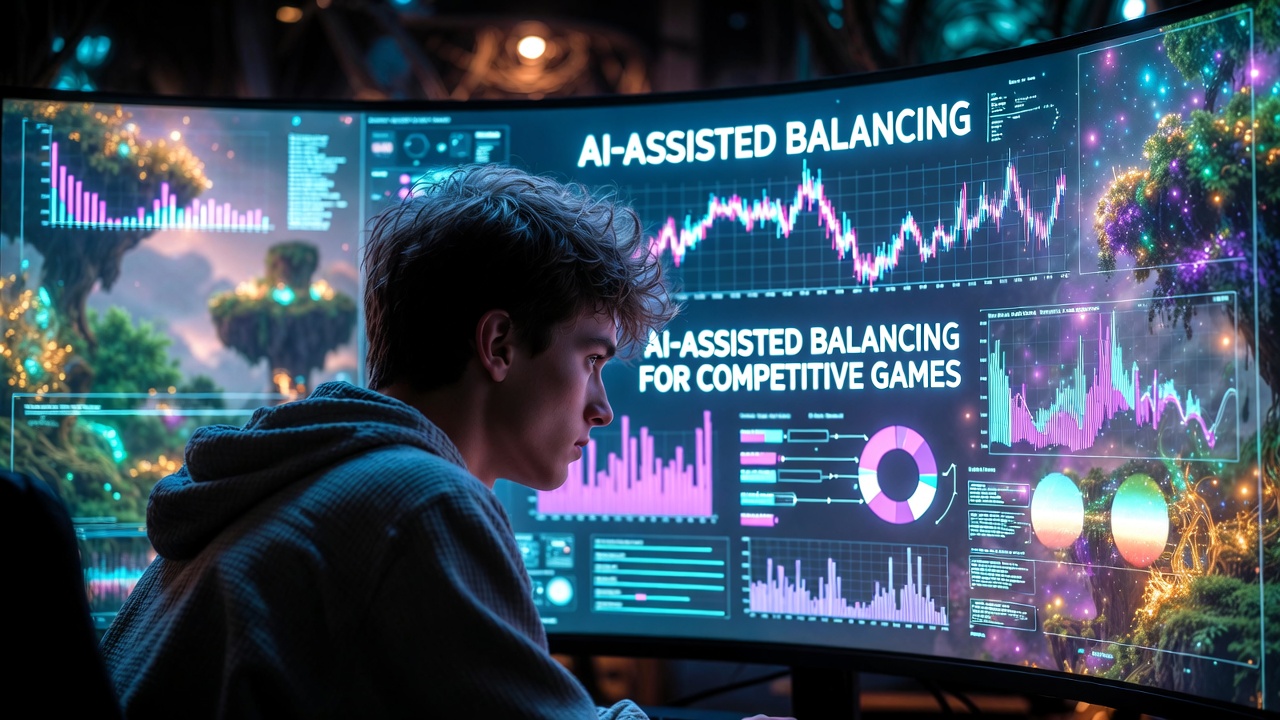
AI-Assisted Balancing for Competitive Games represents one of the most practical near-term applications of machine learning in modern title development. Competitive multiplayer games live or die by their balance—small deviations in weapon power, character abilities, map layouts, or economy curves can turn matches predictable, frustrate players, or create dominant strategies that stifle variety. Traditional balancing relies on designer intuition, playtesting data, and iterative patches, but scales poorly for large rosters, frequent updates, or live-service models with constant content drops.
In 2026, studios increasingly turn to AI-assisted methods to augment human judgment, accelerate iteration cycles, and uncover balance issues before they reach players. AI-Assisted Balancing for Competitive Games does not mean handing final numbers to an algorithm; instead, it means using data-driven simulation, reinforcement learning, and predictive modeling to inform decisions that remain under human oversight.
Why Balancing Remains So Difficult
Competitive balance is multi-dimensional. Designers must consider:
- Win rates across skill brackets
- Pick/ban rates in ranked and tournament play
- Match length and comeback potential
- Counter-play depth (rock-paper-scissors relationships)
- Role diversity and team composition viability
- Meta stability after patches
Manual analysis of telemetry quickly becomes overwhelming. A single patch might introduce dozens of variables, and player behavior evolves rapidly in response. Human playtests capture qualitative feel but rarely generate the volume needed for statistical confidence, especially at high-level play.
AI steps in by scaling simulation far beyond what manual testing achieves. Tools like self-play reinforcement learning (inspired by systems such as AlphaStar or OpenAI Five) allow agents to explore thousands of matchups per hour, revealing emergent strategies and fragility points that designers might miss for months.
Core Techniques in AI-Assisted Balancing
Several approaches have matured enough for production use in competitive titles.
1. Monte Carlo Simulation with Agent Play
Studios run simplified game rulesets through Monte Carlo tree search or fast forward models. Agents trained via reinforcement learning play millions of games under varied conditions. Output metrics include:
- Expected win probability per character/loadout
- Sensitivity analysis (how much a 5% damage buff shifts outcomes)
- Exploit detection (degenerate loops or infinite-stall tactics)
Example: A fighting game studio might simulate 10 million ranked sets with randomized matchmaking to predict tier list shifts before a patch ships.
2. Predictive Modeling from Telemetry
Supervised ML models trained on historical match data forecast win rates for unseen combinations. Features include:
- Player MMR
- Character pick
- Map
- Build/order choices
- Early-game metrics (K/D at 5 minutes, economy at wave 10)
Gradient-boosted trees or neural networks achieve high accuracy on large datasets. The model flags combinations with predicted win rates outside 48–52% as candidates for adjustment.
3. Generative Adversarial Networks for Scenario Generation
GANs or diffusion models generate novel starting conditions, player behaviors, or map variants to stress-test balance. This uncovers edge cases—rare team comps or timing exploits—that traditional QA misses.
4. Reinforcement Learning for Automated Tweaking
Some pipelines use evolutionary algorithms or policy-gradient methods to iteratively adjust numerical values (damage, cooldowns, costs) toward target distributions (e.g., 50% win rate, uniform pick rates). Human designers review and veto proposals.
Realistic Use Cases and Tool Examples
- Riot Games (League of Legends / VALORANT): Uses large-scale simulation and ML to inform patch notes, though final changes remain designer-led. Public GDC talks describe agent-based modeling for champion balance.
- Blizzard (Overwatch / Hearthstone): Employed self-play RL to balance card sets and hero abilities, reducing meta stagnation.
- Indie / Mid-tier studios: Tools like Ludus AI integrate balance simulation modules, allowing smaller teams to run agent matches in Unity/Unreal without building custom infrastructure. Tripo AI helps with rapid asset variants for map balancing experiments.
Limitations remain critical:
- Agents often exploit simulation shortcuts absent in real play (perfect reaction times, no latency).
- Models overfit to current player data, missing future behavioral shifts.
- Black-box adjustments erode designer intuition if over-relied upon.
Best practice combines AI suggestions with human review and targeted playtests.
Example Metrics Dashboard
A typical post-patch monitoring table might look like this (hypothetical data for a MOBA-style title after adjusting three abilities):
| Character | Pre-Patch Win Rate (%) | Post-Patch Win Rate (%) | Pick Rate Change (%) | Ban Rate (%) | Notes |
|---|---|---|---|---|---|
| Hero A | 54.2 | 50.8 | +3.1 | 12.4 | Damage nerf effective |
| Hero B | 46.1 | 49.3 | +8.7 | 4.2 | Mobility buff restored viability |
| Hero C | 51.9 | 53.4 | -2.6 | 18.9 | Still dominant; monitor |
| Overall | 50.0 | 50.1 | – | – | Global balance improved |
Such tables, updated daily from live telemetry, guide hotfixes.
- For more on simulation in world design, see related articles on AI and Build Optimization for Large Worlds and Procedural Combat Encounters With Machine Learning.
- External reading: Check OpenAI’s work on self-play in Dota 2 for foundational techniques, DeepMind’s AlphaStar balancing insights, and GDC Vault talks on ML in live-service balance.
FAQ
Q: Does AI-Assisted Balancing for Competitive Games remove the need for human designers? A: No. AI surfaces data and proposals; humans interpret context, preserve creative vision, and ensure the game feels fair and fun beyond numbers.
Q: How accurate are AI balance predictions in live games? A: In controlled environments, 85–95% accuracy on win-rate prediction is common with large datasets. Real-world accuracy drops to 70–85% due to patches, player adaptation, and toxicity factors.
Q: What data volume is required to start using these methods? A: At least 100,000–500,000 matches for reliable modeling. Smaller titles bootstrap with simulated self-play before live launch.
Q: Can indie studios afford AI balancing tools? A: Yes—cloud-based platforms like Ludus or open-source RL libraries (Stable-Baselines3, Ray RLlib) lower the barrier. Costs scale with compute, not team size.
Q: What happens when AI suggests controversial changes? A: Studios maintain veto power. Many publicly share AI insights in patch notes to build transparency and community trust.
Key Takeaways
- AI-Assisted Balancing for Competitive Games augments, rather than replaces, human expertise by scaling simulation and prediction.
- Techniques like self-play RL, telemetry modeling, and automated tweaking uncover issues faster than manual methods alone.
- Success depends on combining AI outputs with designer judgment, targeted testing, and continuous monitoring.
- Limitations—simulation-reality gaps, overfitting, interpretability—require cautious adoption.
- Studios that integrate these tools thoughtfully gain faster iteration, more stable metas, and longer player retention in competitive titles.
Looking forward, AI-Assisted Balancing for Competitive Games will evolve toward real-time adaptive systems that adjust matchmaking, MMR, or even light rules during seasons. The goal remains constant: create deep, fair, and evolving competition that rewards skill over discovery of broken mechanics. As tools mature, the studios that master this hybrid approach will define the next era of competitive play. For deeper explorations of related systems, continue reading the series on 24-Players.com.
Leave a Reply