
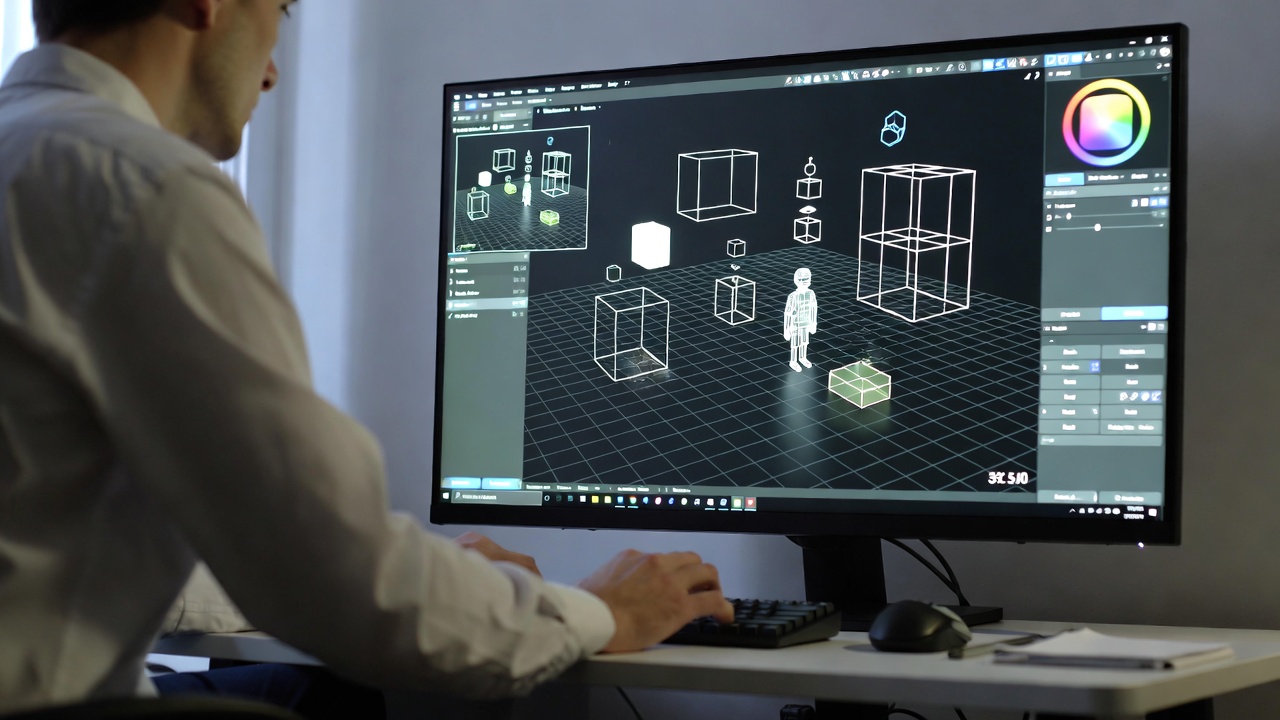
AI as a Co-Designer: Where Human Creativity Still Wins
AI as a Co-Designer: Where Human Creativity Still Wins represents one of the most balanced and realistic applications of artificial intelligence in modern game development. As tools evolve rapidly in 2026, studios increasingly integrate AI into creative pipelines not to replace designers, but to augment their decision-making, iteration speed, and exploration of possibilities. The core thesis remains clear: AI excels at scale, variation, and pattern recognition, yet human creativity still wins when it comes to intentionality, emotional resonance, cultural nuance, and true innovation.
In practice, AI as a Co-Designer: Where Human Creativity Still Wins manifests through collaborative workflows where designers set high-level goals, constraints, and aesthetic visions, while AI handles combinatorial heavy lifting. This hybrid approach preserves the irreplaceable elements of human insight while leveraging AI’s strengths in rapid prototyping and idea expansion.
The Current Landscape of AI Co-Design Tools
Game development in 2026 benefits from a maturing ecosystem of AI tools designed explicitly for creative collaboration rather than full automation.
- Ludus AI provides structured co-design environments where developers input design pillars (e.g., “open-world survival with horror elements”), and the system generates branching mechanics, level layouts, and narrative beats. Its strength lies in maintaining coherence across suggestions.
- Procedural systems enhanced by ML (such as those built on top of Houdini or custom Unity/ML-Agents integrations) allow designers to train models on curated examples, then generate variations that respect learned rules.
- Text-to-concept pipelines like Midjourney, Stable Diffusion variants tuned for game art, or Tripo AI for 3D asset blocking serve as visual brainstorming partners.
These tools shift the design process from blank-canvas paralysis to guided iteration. A designer might sketch a rough biome concept, feed it into an image-to-3D tool like Tripo, refine the output, and use Ludus to suggest interactive elements that fit the mood.
Practical Examples: AI in Action Across Development Stages
Concept and Pre-Production
In early ideation, AI accelerates divergence. For a sci-fi exploration game, a designer might prompt for “10 faction archetypes inspired by Dune and Mass Effect but with original twists.” AI delivers dozens of variants in minutes—each with lore summaries, visual mood boards, and potential conflict hooks. The human designer then selects, merges, and refines three to five concepts, injecting personal vision (e.g., emphasizing themes of isolation that resonate personally or culturally).
This process cuts concept time from weeks to days without sacrificing originality, because the final direction always stems from human curation.
Mechanics and Systems Design
Consider dynamic economies in simulation games. A designer defines core variables (supply/demand curves, scarcity triggers) and constraints (no infinite money exploits). An ML model trained on historical player data or simulated runs proposes balancing tweaks—adjusting spawn rates, crafting costs, or NPC behaviors. The designer reviews outputs, rejects those that feel “gamey” or unfair, and iterates with new constraints.
Real-world case: Studios using reinforcement learning setups (e.g., via Unity ML-Agents or custom PyTorch pipelines) report 40-60% faster iteration on systemic balance, but human oversight remains essential to prevent emergent behaviors that feel exploitative or immersion-breaking.
Level and World Design
AI shines in generating modular content. Tools like Dungeon Alchemist or ML-augmented versions of World Machine create base layouts, which designers then hand-tune for pacing, visual hierarchy, and narrative beats. For example, an AI might produce 50 dungeon room combinations based on a graph grammar; the designer selects a subset, reorders them for rising tension, and adds unique set-pieces that carry emotional weight.
Here, AI as a Co-Designer: Where Human Creativity Still Wins becomes evident: AI handles combinatorial explosion, but humans ensure meaningful progression, surprise, and thematic consistency.
Strengths and Limitations: A Balanced View
AI co-design offers clear advantages:
- Speed of iteration — Generate and evaluate hundreds of ideas where manual methods allow dozens.
- Overcoming bias — Expose designers to unconventional combinations they might not consider.
- Scalability — Handle volume required for large open worlds or live-service content.
But limitations persist:
- Lack of intentionality — AI suggestions derive from training data patterns, not purposeful creative intent.
- Context blindness — Models struggle with unspoken cultural, emotional, or brand-specific constraints unless explicitly guided.
- Novelty ceiling — True groundbreaking ideas (e.g., the portal mechanic in Portal) remain human breakthroughs; AI excels at recombination, not invention from first principles.
Comparison Table: Human vs. AI vs. Hybrid in Key Design Tasks
| Design Task | Pure Human Approach | Pure AI Approach | Hybrid (AI as Co-Designer) | Winner & Why |
|---|---|---|---|---|
| Initial Concept Brainstorming | Slow, prone to tunnel vision | Fast, high volume, often generic | Fast volume + human curation | Hybrid – breadth meets depth |
| Mechanic Balancing | Intuitive but time-intensive testing | Data-driven but lacks feel | ML suggestions refined by playtesting intuition | Hybrid – numbers + human taste |
| Level Layout Generation | Highly bespoke, slow | Fast but repetitive or incoherent | AI bases + human editing for flow & theme | Hybrid – efficiency without losing soul |
| Narrative Branching | Deep emotional resonance | Logical but shallow | AI variants + human emotional weighting | Human (with AI support) – emotion wins |
This table illustrates why AI as a Co-Designer: Where Human Creativity Still Wins holds true: the most effective outcomes emerge when AI handles scale and humans provide meaning.
External Resources for Deeper Exploration
- Unity ML-Agents documentation – Practical guide to training behavioral models.
- GDC 2025 talk on AI-assisted design pipelines – Industry examples of hybrid workflows.
- Tripo AI official site – Details on text-to-3D for rapid blocking.
- Ludus AI platform overview – Structured co-design features.
- NVIDIA research on generative agents for games – Cutting-edge simulation of NPC societies.
Internal Links for Related Reading
For more on practical AI integration, see:
- Ludus AI: What It Gets Right for Game Dev Pipelines
- Tripo AI Explained for Indie and Studio Developers
- Best AI Tools for Worldbuilding in 2026
- AI Tools That Actually Save Time in Game Development
- Where AI Tools Still Fall Short for Game Studios
FAQ
Q: Does using AI as a co-designer reduce the need for experienced designers? A: No. It amplifies their productivity but increases the demand for strong taste, vision, and constraint-setting skills. Junior roles may shift toward implementation, while seniors focus more on curation and innovation.
Q: Can AI ever lead to truly original game ideas? A: Rare. Most breakthroughs come from human synthesis of disparate influences. AI accelerates recombination but rarely originates paradigm shifts without human direction.
Q: How do studios avoid over-reliance on AI outputs? A: By enforcing strict human veto power, maintaining diverse training datasets, and regularly auditing for homogenization. Many teams use “AI-off” design sprints to ensure core ideas remain human-driven.
Q: What metrics show hybrid design success? A: Studios report 30-70% faster pre-production, higher concept diversity scores (internal reviews), and improved player feedback on novelty, though qualitative “feel” remains the ultimate judge.
Q: Is this approach accessible to indie developers? A: Yes—cloud-based tools like Ludus, Tripo, and open-source ML frameworks lower barriers significantly compared to 2023.
Key Takeaways
- AI as a Co-Designer: Where Human Creativity Still Wins defines the dominant paradigm in 2026 game development.
- AI excels at volume, variation, and data-driven refinement; humans dominate in purpose, emotion, and breakthrough thinking.
- Successful studios treat AI as a powerful apprentice—capable, fast, but always under directed guidance.
- Hybrid workflows deliver faster iteration without sacrificing soul or originality.
- The future favors designers who master both creative intuition and AI orchestration.
As game development continues evolving, the studios that thrive will be those that view AI not as a shortcut, but as a multiplier for human imagination. The tools grow more sophisticated each year, yet the spark of purposeful creativity—the ability to say “this feels right” or “this changes everything”—remains profoundly human. That edge ensures human creativity still wins, even as AI becomes an indispensable co-designer.
Leave a Reply