
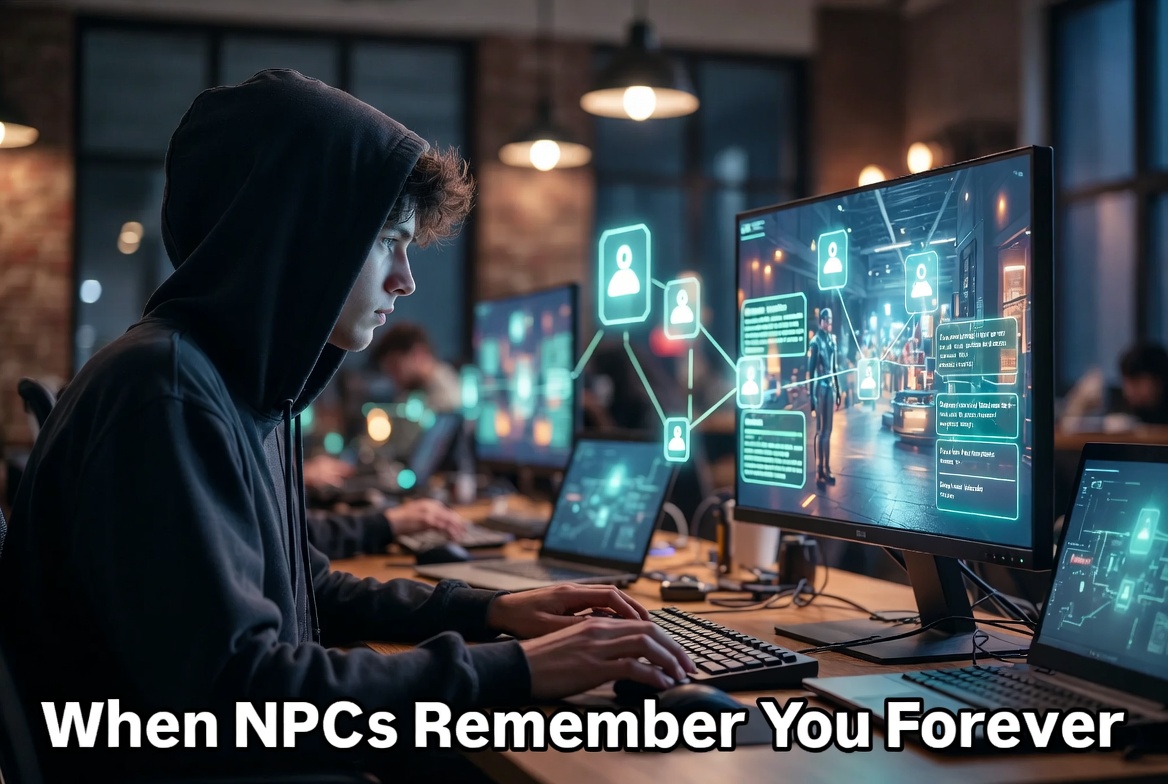
When NPCs Remember You Forever
When NPCs remember you forever represents a significant advancement in how non-player characters function within interactive worlds. Instead of resetting behaviors or relying on simple reputation scores that fade, persistent memory systems allow AI agents to retain detailed histories of player interactions, decisions, and events across extended periods—potentially entire campaigns or even across multiple play sessions. This capability transforms NPCs from scripted responders into entities with continuity, enabling deeper relationships, long-term consequences, and more believable social simulations.
In conventional game design, NPC memory is often limited or compartmentalized to manage scope and performance. When NPCs remember you forever, the simulation gains a new dimension of realism and emotional weight. A minor act of kindness or betrayal can influence dialogue, trade terms, alliances, or even world events months of in-game time later, creating investment that static characters rarely achieve.
Foundations of Persistent NPC Memory Systems
Persistent memory in NPCs draws from several technical approaches that work together to create continuity without overwhelming computational resources:
- Vector Embeddings and Semantic Storage: Player actions and conversations are encoded into high-dimensional vectors, allowing efficient similarity searches. An NPC can later retrieve and reference contextually relevant past events.
- Graph-Based Relationship Modeling: Social networks track connections, trust levels, debts, and shared histories between characters, with updates propagating through the simulation.
- Hierarchical Memory Layers: Short-term episodic memory handles immediate context, while long-term semantic memory stores generalized knowledge and key milestones.
- Forgetting Mechanisms with Purpose: Not all details persist equally; systems use decay functions or relevance scoring to prioritize emotionally or strategically significant memories, preventing bloat.
Tools like Ludus support prototyping advanced agent memory behaviors, while procedural systems and ML pipelines help tune how memories influence decision-making. Tripo and similar pipelines can generate or adapt visual and animation assets that reflect accumulated history, such as changed appearances or customized greetings.
How Persistent Memory Enhances Gameplay and Narrative
When NPCs remember you forever, several gameplay layers gain depth:
Relationship Dynamics Characters develop nuanced attitudes based on cumulative interactions. A merchant might offer better prices or exclusive items after consistent fair dealings, or refuse service following repeated thefts, with justifications rooted in remembered events.
Long-Term Consequences Early choices ripple forward. Helping a struggling settlement could lead to reinforcements or resources appearing in a distant conflict seasons later, as survivors spread stories through the NPC network.
Emergent Social Simulations Agents share information, forming collective memories or rumors that evolve independently. A player’s reputation might precede them in new regions through gossip chains modeled via multi-agent communication.
Personalized Storytelling Dialogue and quests adapt based on history. NPCs reference specific past events, creating a sense of a shared history rather than generic responses.
These features align with research in lifelong learning agents and memory-augmented reinforcement learning, with practical explorations documented in game AI literature and conference proceedings.
Related discussions on 24-Players.com include AI, Agency, and Player Responsibility, Can AI Create Meaningful Player Choice?, and Designing for Unpredictable AI Outcomes.
Practical Examples and Implementation Patterns
In open-world RPGs or persistent simulations, NPCs with lasting memory can drive faction politics where past player interventions shape power structures over time. In narrative adventures, companions might evolve unique personalities and story arcs based on choices made dozens of hours earlier.
Simulation or strategy games benefit when leaders and populations retain historical grievances or alliances, leading to organic diplomatic shifts rather than reset states after each major event.
External resources, such as academic work on episodic memory in AI agents and documentation for advanced game AI frameworks, provide grounding for scalable implementations.
Strengths and Limitations
Strengths
- Increased emotional engagement through genuine continuity and perceived agency.
- Higher replay value as different interaction histories produce distinct world states.
- Richer social and political layers without requiring exhaustive manual scripting.
- Support for persistent worlds where player legacy feels tangible.
Limitations
- Risk of negative persistence—early mistakes haunting players indefinitely in ways that frustrate rather than engage.
- Higher storage and computation needs for tracking and querying large memory stores across many agents.
- Challenges in balancing memory influence so it enhances rather than overwhelms core gameplay loops.
- Difficulty ensuring consistency when memory retrieval produces conflicting or outdated interpretations.
Hybrid approaches that combine persistent memory with periodic summarization or player-visible “memory management” tools help mitigate many of these issues.
Comparison of NPC Memory Approaches
| Aspect | Basic State/Flag Systems | Persistent Memory (When NPCs Remember You Forever) | Hybrid Memory Systems |
|---|---|---|---|
| Continuity Depth | Shallow, resets easily | Deep and cumulative across sessions | Tunable layers with summarization |
| Emotional Impact | Limited | High through referenced history | Strong with controlled relevance |
| Scalability | High | Medium to high with optimization | Balanced for production |
| Player Agency Feedback | Often explicit but mechanical | Contextual and narrative | Clear attribution tools |
| Risk of Frustration | Low | Higher without safeguards | Reduced through design guardrails |
| Development Complexity | Low | Higher upfront for architecture | Moderate with modular components |
This table shows why many studios adopt hybrid memory designs when aiming for experiences where NPCs remember you forever without sacrificing performance or accessibility.
Design Best Practices
To implement effective persistent memory:
- Prioritize relevance scoring during storage and retrieval to focus on high-impact events.
- Offer players insight into how NPCs perceive them, such as through reputation summaries or reflective dialogue.
- Use phased memory rollout—introduce simple persistence early, then expand complexity as systems prove stable.
- Incorporate forgiveness or redemption mechanics that allow memory evolution rather than permanent locks.
- Test extensively with long play sessions to identify and tune emergent issues arising from accumulated histories.
Further technical insights are available in resources on memory-augmented AI and social simulation frameworks.
FAQ
Q: Does persistent NPC memory require always-online features or cloud saves? A: No. Local vector databases and efficient compression allow robust offline persistence, with optional cloud synchronization for cross-device continuity.
Q: Can players reset or manage NPC memories if they become burdensome? A: Many designs include in-game mechanisms like apologies, quests for redemption, or memory-altering artifacts to give players agency over long-term consequences.
Q: How do developers prevent memory systems from creating unbalanced advantages or exploits? A: Through careful reward shaping, decay functions, and runtime monitoring that maintains fairness while preserving persistence.
Q: Will NPC memory make games feel too punishing for casual players? A: Thoughtful calibration, difficulty sliders for memory influence, and forgiving early-game systems help ensure accessibility without diluting depth for dedicated players.
Q: What hardware advancements would most improve large-scale persistent memory? A: Faster on-device vector search, increased memory bandwidth, and dedicated AI accelerators will enable richer simulations with more agents and longer histories.
Key Takeaways
- When NPCs remember you forever, games gain continuity that strengthens relationships, consequences, and world believability.
- Vector embeddings, graph models, and hierarchical architectures form the technical backbone of effective systems.
- Hybrid designs balance depth with playability, using summarization and feedback tools to manage complexity.
- Success depends on relevance tuning, player visibility into memory effects, and safeguards against negative persistence.
- As memory techniques mature, NPCs will evolve from functional elements into compelling co-inhabitants of dynamic worlds.
Looking ahead, when NPCs remember you forever will become a baseline expectation in many genres, enabling persistent worlds where player actions contribute to an evolving social fabric. This shift supports experiences that feel more alive and personally significant, as characters carry forward the weight of shared history. Combined with advances in agent intelligence and simulation scale, it points toward interactive entertainment where legacy and reputation carry genuine meaning across time.
For additional perspectives, explore AI as the Backbone of Persistent Worlds, Simulated Civilizations Powered by AI, and Building Living Game Worlds at Scale on 24-Players.com. External references worth reviewing include research on lifelong AI learning, multi-agent social modeling, and practical implementations in modern game engines.
The future of game worlds lies in systems that not only react but retain and reflect—creating spaces where every interaction contributes to a living history that endures alongside the player.
Leave a Reply