
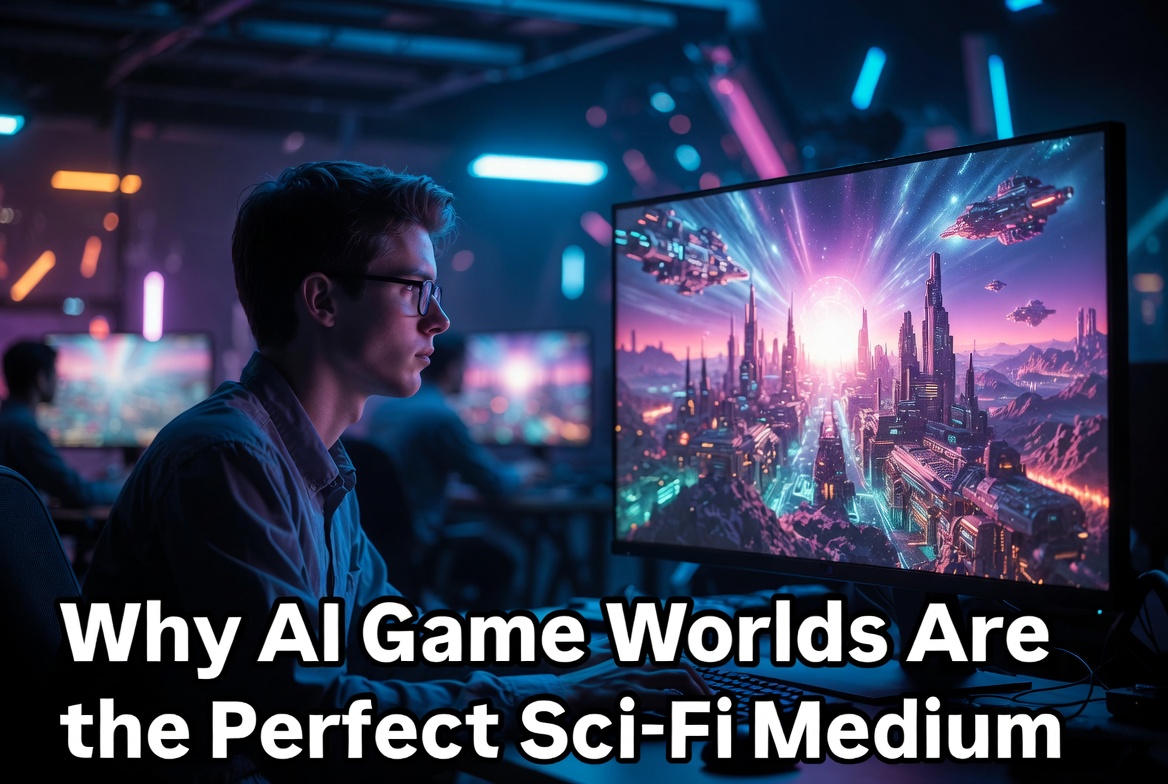
Why AI Game Worlds Are the Perfect Sci-Fi Medium
Why AI game worlds are the perfect sci-fi medium stems from the natural alignment between the genre’s core themes and the capabilities of modern artificial intelligence systems. Science fiction has always explored concepts of advanced technology, sentient machines, vast simulated realities, and evolving civilizations. AI-powered game development now allows studios to realize these ideas not as static backdrops or scripted sequences, but as dynamic, responsive systems that players can interact with in meaningful ways. The medium gains authenticity when the technology powering the game mirrors the speculative technologies depicted within it.
In traditional sci-fi games, worlds often serve as elaborate sets for linear or branching stories. With AI, these worlds become living simulations where agents learn, societies adapt, environments evolve, and consequences unfold from player decisions in ways that echo classic sci-fi narratives about emergence, agency, and the unknown. This convergence makes AI game worlds uniquely suited to deliver immersive, replayable experiences that feel true to the genre’s spirit of wonder and exploration.
The Thematic Synergy Between Sci-Fi and AI Systems
Sci-fi frequently centers on questions of consciousness, simulation, human-machine boundaries, and large-scale systems that exceed individual control. AI game worlds operationalize these themes directly:
- Sentience and Agency: AI agents equipped with memory, goals, and adaptive decision-making can portray synthetic beings or alien intelligences that develop relationships, rivalries, or philosophies based on interactions.
- Simulated Realities: Procedural and learning-based systems create nested or layered worlds where players question the nature of their environment, much like stories involving virtual realities or matrix-like constructs.
- Emergent Civilizations: Multi-agent models simulate cultural drift, technological progress, and societal shifts at scales impossible to hand-author, reflecting sci-fi tropes of galactic empires or post-human societies.
- Unpredictable Futures: Reinforcement learning and evolutionary algorithms introduce genuine novelty, allowing narratives to branch in directions that surprise both players and designers.
This synergy elevates the genre beyond visual spectacle or lore dumps into interactive thought experiments. Tools such as Ludus for behavior prototyping and Tripo for asset generation help integrate these elements efficiently into cohesive sci-fi settings, while ML pipelines enable ongoing adaptation without constant manual intervention.
Technical Foundations Enabling Sci-Fi Authenticity
Several AI-driven techniques make game worlds feel convincingly futuristic:
Multi-Scale Agent Simulations Individual characters operate with personal histories and motivations, while higher-level systems model factions, economies, or ecosystems. A player’s intervention in one sector can cascade into political upheaval or technological breakthroughs across star systems.
Persistent Memory Architectures Vector databases or graph-based memory allow entities to retain context across extended play sessions. An AI companion might reference events from dozens of hours earlier, creating continuity that reinforces themes of time, legacy, and evolving relationships common in sci-fi.
Procedural Generation with Learning Layers Base terrain, flora, fauna, and architecture generate procedurally, then adapt through ML models based on environmental pressures or player influence. This produces planets or megastructures that feel alive and responsive rather than prefabricated.
Hybrid Narrative Systems Authored high-level arcs provide thematic direction, while AI fills in micro-events, dialogue variations, and consequence chains. The result respects writer intent while delivering breadth and replayability.
Research into multi-agent reinforcement learning and procedural content generation, available through academic sources and industry conferences, continues to refine these capabilities for large-scale sci-fi implementations.
For related perspectives, 24-Players.com explores topics including AI as a Worldbuilding Engine, Simulated Civilizations Powered by AI, and When Games Become Living Systems.
Practical Examples in Sci-Fi Game Development
Contemporary and upcoming projects illustrate the potential:
- Exploration titles where discovered alien ruins contain AI remnants that learn from player behavior and gradually reveal or alter their objectives.
- Empire-building games in which subject species or synthetic populations develop unique cultural identities and diplomatic strategies through repeated interactions.
- Narrative-driven adventures set in simulated universes where the boundary between player actions and the “reality” of the game world becomes a central plot element.
These examples leverage AI to create depth that static sci-fi settings struggle to achieve at comparable scale.
External resources offering deeper technical or conceptual insight include studies on agent-based modeling in interactive environments and discussions of AI applications in narrative design.
Strengths and Limitations
Strengths
- Authentic representation of sci-fi concepts through systems that actually exhibit emergence and adaptation.
- High replayability as each playthrough can explore alternate technological or societal paths.
- Scalable world-building that reduces manual content creation while increasing variety.
- Opportunities for players to engage with philosophical questions through direct interaction rather than exposition.
Limitations
- Risk of diluting strong thematic focus if emergent behaviors stray too far from intended narrative tone.
- Computational demands of running complex simulations, particularly for expansive galactic scales.
- Challenges in guiding player discovery so that sci-fi wonder remains accessible rather than overwhelming.
- Need for robust safety mechanisms to prevent unwanted or thematically inconsistent outcomes.
Hybrid designs—pairing strong authorial vision with constrained AI variability—currently provide the most effective balance when building AI game worlds for sci-fi experiences.
Comparison of World-Building Approaches in Sci-Fi Games
| Aspect | Traditional Scripted Sci-Fi Worlds | AI-Driven Dynamic Sci-Fi Worlds | Hybrid Sci-Fi Implementation |
|---|---|---|---|
| Thematic Fidelity | High through authored lore | Variable—depends on training alignment | Strong with guided emergence |
| Scale and Variety | Limited by production resources | High through procedural and learning systems | Balanced and controllable |
| Player Agency Impact | Mostly within predefined branches | Systemic and long-term | Meaningful within thematic bounds |
| Replayability | Moderate | Very high | High with narrative coherence |
| Development Scalability | Resource-intensive for unique content | Upfront investment in models and data | Efficient combination of both |
| Immersion Through Surprise | Low to medium | High when coherent | Optimized through feedback tools |
This comparison demonstrates why AI game worlds are increasingly viewed as the ideal vehicle for ambitious sci-fi projects.
Design Considerations for Sci-Fi AI Worlds
Successful implementations focus on:
- Establishing clear thematic constraints and reward structures during model training to keep emergence aligned with genre tone.
- Providing layered discovery tools—scanners, logs, or AI companions—that help players uncover and interpret complex system behaviors.
- Using phased content reveals where early gameplay introduces core mechanics before expanding to galaxy-spanning simulations.
- Incorporating player feedback mechanisms that allow communities to influence high-level parameters without breaking individual save integrity.
- Balancing spectacle with substance by ensuring visual and auditory feedback reinforces the intelligence of underlying systems.
Additional guidance appears in resources focused on AI integration for narrative-rich environments and scalable simulation techniques.
FAQ
Q: Do AI game worlds require players to understand the underlying technology to enjoy sci-fi stories? A: No. Effective designs surface complex systems through intuitive interactions, environmental storytelling, and clear cause-and-effect feedback rather than exposing algorithms.
Q: Can AI maintain consistent tone and themes across unpredictable outcomes? A: Yes, through careful curation of training data, reward shaping, and runtime guardrails that preserve core narrative or aesthetic direction.
Q: How accessible are these experiences on standard consumer hardware? A: Hierarchical simulation techniques and model optimization allow rich experiences on modern devices, with cloud components optionally enhancing larger-scale elements.
Q: Will AI game worlds make traditional linear sci-fi narratives obsolete? A: Unlikely. Many titles will continue blending strong authored stories with dynamic background systems, offering multiple ways to engage with the genre.
Q: What role do human writers and designers retain in AI-driven sci-fi projects? A: A central one—defining high-level themes, emotional arcs, ethical dilemmas, and the philosophical questions that give the experience meaning.
Key Takeaways
- AI game worlds are the perfect sci-fi medium because they translate genre themes of technology, emergence, and simulation into playable systems rather than mere presentation.
- Success requires hybrid architectures that combine authorial vision with adaptive intelligence to maintain coherence.
- Memory systems, multi-agent modeling, and constrained procedural generation enable authentic scale and responsiveness.
- Feedback and explanation tools help translate complexity into wonder and discovery for players.
- As techniques advance, these worlds will support deeper engagement with speculative ideas through direct interaction.
Looking forward, why AI game worlds are the perfect sci-fi medium will only become clearer as hardware, models, and integration methods improve. Interactive experiences will increasingly function as collaborative simulations where players co-author futures alongside intelligent systems, blurring lines between story, gameplay, and speculation. This positions sci-fi games at the forefront of exploring what interactive media can become when powered by the very technologies it imagines.
Readers seeking further exploration may turn to The Line Between Simulation and Story, Why Sci-Fi Games Will Lead AI Innovation, and Building Living Game Worlds at Scale on 24-Players.com. Valuable external references include research on multi-agent systems for narrative applications, procedural generation techniques tailored to science fiction settings, and industry discussions on AI’s role in speculative world-building.
In the long term, AI game worlds promise to deliver science fiction that feels not just depicted, but inhabited—worlds where technology serves as both setting and active participant, inviting players to ponder the same profound questions that have defined the genre for decades.
Leave a Reply