
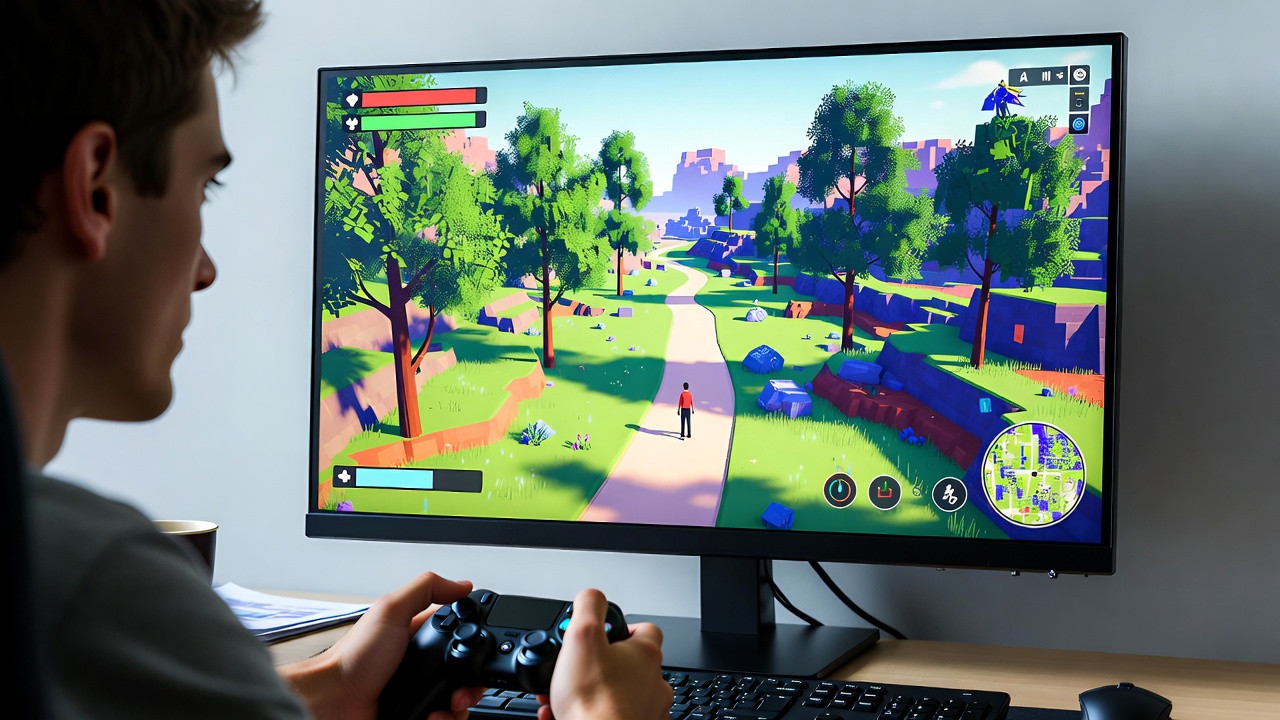
What Makes a Simulation Game “AI-Powered”?
Several technical layers typically converge in modern AI-powered simulation games:
- Agent-Based Modeling: Individual NPCs, animals, resources, or even abstract concepts (like “public opinion” in a political sim) operate as autonomous agents. Each possesses goals, memory, and decision-making capabilities powered by reinforcement learning, decision trees enhanced with ML, or large language models for dialogue and reasoning.
- Procedural Systems with Feedback: Terrain, weather, resource distribution, and social dynamics generate on the fly but adjust according to ongoing simulation states rather than one-time rolls.
- Machine Learning Pipelines: Offline-trained models handle balancing, content generation, or behavior prediction; online models adapt in real time to player strategies.
- Simulation Layers: Multi-scale systems run in parallel—micro (individual daily routines), meso (city or faction economies), and macro (planetary or galactic trends).
Examples of tools and approaches include frameworks like Ludus for rapid prototyping of AI behaviors, Tripo for 3D asset integration into simulated environments, and open-source libraries such as Unity ML-Agents or custom Godot extensions for training agents directly within the engine.
Core Components of AI-Powered Simulation Games
1. Autonomous Agents and Memory Systems
In AI-powered simulation games, agents maintain persistent memory. A villager might remember a player’s decision to raise taxes three in-game years ago and adjust loyalty or migration behavior accordingly. This requires efficient vector databases or compressed state representations to scale to thousands of entities without performance collapse.
2. Multi-Layered Economies and Ecosystems
Resource chains become dynamic. An overfished lake affects not only fish populations but also trade routes, cuisine preferences, and political stability in neighboring regions. AI models simulate supply and demand with noise and external shocks, creating believable scarcity and abundance cycles.
3. Emergent Narrative Generation
While not every simulation produces a traditional story, chains of cause and effect often coalesce into compelling arcs. A rogue AI agent in a cyberpunk city sim might spark a rebellion that players can join, ignore, or suppress—each choice rippling through the larger system.
4. Player Interaction Depth
Players influence the simulation at multiple scales: direct commands to individual agents, policy-level decisions, or even meta-level modifications to the underlying rules (within designed guardrails).
Practical Examples in Current and Near-Future Titles
Several released and in-development projects illustrate these principles:
- Strategy games where factions evolve ideologies based on repeated interactions rather than fixed tech trees.
- Life simulators in which household members develop genuine rivalries, alliances, and skill specializations through reinforcement learning from daily experiences.
- Grand strategy titles that simulate entire civilizations with cultural drift, technological diffusion, and climate feedback loops driven by neural networks.
Research from institutions exploring multi-agent systems (such as papers on arXiv covering scalable agent simulations) and industry talks at GDC highlight how these systems reduce the need for exhaustive manual scripting while increasing replayability.
Strengths and Limitations
Strengths
- High replayability: No two playthroughs unfold identically.
- Deep player agency: Actions carry lasting consequences.
- Efficient content scaling: The simulation generates situations that would be prohibitively expensive to author manually.
- Educational potential: Complex systems modeling helps players understand real-world dynamics like economics, ecology, or sociology.
Limitations
- Unpredictability can frustrate players seeking clear goals or balanced challenge curves.
- Computational cost remains high for large-scale simulations on consumer hardware.
- Debugging emergent behaviors demands specialized tools and significant testing time.
- Risk of “dead” simulations if agents converge on suboptimal equilibria without sufficient diversity injection.
A balanced approach often combines AI-driven simulation with designer-defined anchor points—key events, win conditions, or narrative scaffolds—that prevent the system from drifting into unengaging states.
Comparison of Simulation Approaches
| Aspect | Traditional Simulation | AI-Powered Simulation | Hybrid Approach (Recommended) |
|---|---|---|---|
| Behavior Definition | Hand-crafted rules and scripts | Learned policies and adaptive models | Core rules + ML overrides for edge cases |
| Scalability | Good for small-to-medium systems | Excellent for large populations with optimization | Strong, with controllable compute budget |
| Replayability | Moderate (seed variation) | Very high (emergent interactions) | High, with guided variety |
| Development Effort | High initial scripting | High training and validation time | Medium—leverages both human insight and AI |
| Player Predictability | High | Low to medium | Tunable via designer controls |
| Debugging Difficulty | Low to medium | High | Medium (tools for inspecting agent decisions) |
This table illustrates why many studios gravitate toward hybrid models when building AI-powered simulation games. Pure AI systems excel at variety but benefit from human oversight to maintain coherence and fun.
Designing for Stability and Fun
Successful AI-powered simulation games incorporate several practical techniques:
- Guardrails and Intervention Layers: Developers can pause, nudge, or reset subsystems without breaking immersion.
- Difficulty and Complexity Sliders: Players or automatic systems adjust agent intelligence, simulation speed, or randomness.
- Observation and Explanation Tools: In-game interfaces that explain why an event occurred (“Faction X rebelled due to cumulative resource inequality over 12 turns”).
- Seeded Randomness with Controlled Variance: Ensures reproducibility for sharing or competitive play while preserving emergence.
External resources such as the Unity ML-Agents toolkit documentation and research from the Multi-Agent Reinforcement Learning community provide valuable implementation patterns.
For related reading on 24-Players.com, consider exploring How AI Enables Emergent Gameplay, Designing for Unpredictable AI Outcomes, and AI as a Worldbuilding Engine—all of which expand on specific aspects touched here.
Additional context appears in external sources: Stanford’s work on agent-based modeling, NVIDIA’s research on GPU-accelerated simulations, and the Procedural Generation subreddit discussions on integrating ML with classical techniques.
FAQ
Q: Do AI-powered simulation games require constant internet connectivity? A: Not necessarily. Many run entirely offline once models are trained and quantized for deployment. Cloud components may handle optional features like cross-player simulation sharing or advanced training.
Q: Can these games work on lower-end hardware? A: Yes, through aggressive optimization—model distillation, hierarchical simulation (detailed only near the player), and fallback deterministic modes. However, the richest experiences still benefit from modern GPUs or NPUs.
Q: How do developers prevent toxic or unwanted emergent behaviors? A: Through reward shaping during training, runtime safety filters, extensive playtesting with diverse agent populations, and modular design that allows hot-swapping problematic subsystems.
Q: Are AI-powered simulation games more expensive to develop than traditional titles? A: Initial costs can be higher due to training infrastructure and expertise needs, but long-term savings emerge in reduced content authoring and higher replay value, which supports live-service or DLC strategies.
Q: Will AI-powered simulation games eventually make linear story-driven games obsolete? A: Unlikely. Different player preferences coexist. Many titles will continue blending strong authored narratives with simulated background worlds for the best of both worlds.
Key Takeaways
- AI-powered simulation games shift the developer role from scripting every outcome to designing robust systems and meaningful intervention points.
- Success depends on balancing emergence with coherence—too much chaos frustrates, too little predictability bores.
- Hybrid architectures that combine classical simulation with machine learning currently deliver the most reliable results.
- Computational efficiency, debugging tools, and player-facing explanation systems remain critical areas for ongoing research and engineering.
- These games excel at delivering personalized, long-term engagement but require careful tuning to respect player time and expectations.
Looking forward, AI-powered simulation games point toward interactive experiences that feel truly alive. As hardware improves and training techniques mature, the boundary between game and persistent, evolving world will continue to blur. Studios that master the integration of human creativity with autonomous systems will define the next decade of simulation design—crafting environments where every decision matters and every playthrough tells its own story.
Related explorations on 24-Players.com include deeper dives into Simulated Civilizations Powered by AI, When Games Become Living Systems, and The Line Between Simulation and Story. External references worth reviewing include OpenAI’s work on multi-agent environments, the Game AI Pro series, and recent SIGGRAPH papers on real-time procedural worlds.
In the long term, AI-powered simulation games do more than entertain—they serve as laboratories for understanding complex systems and as canvases for player-driven history. The medium is only beginning to reveal its full potential.
Leave a Reply