AI in QA Testing Faster Bugs Better Games
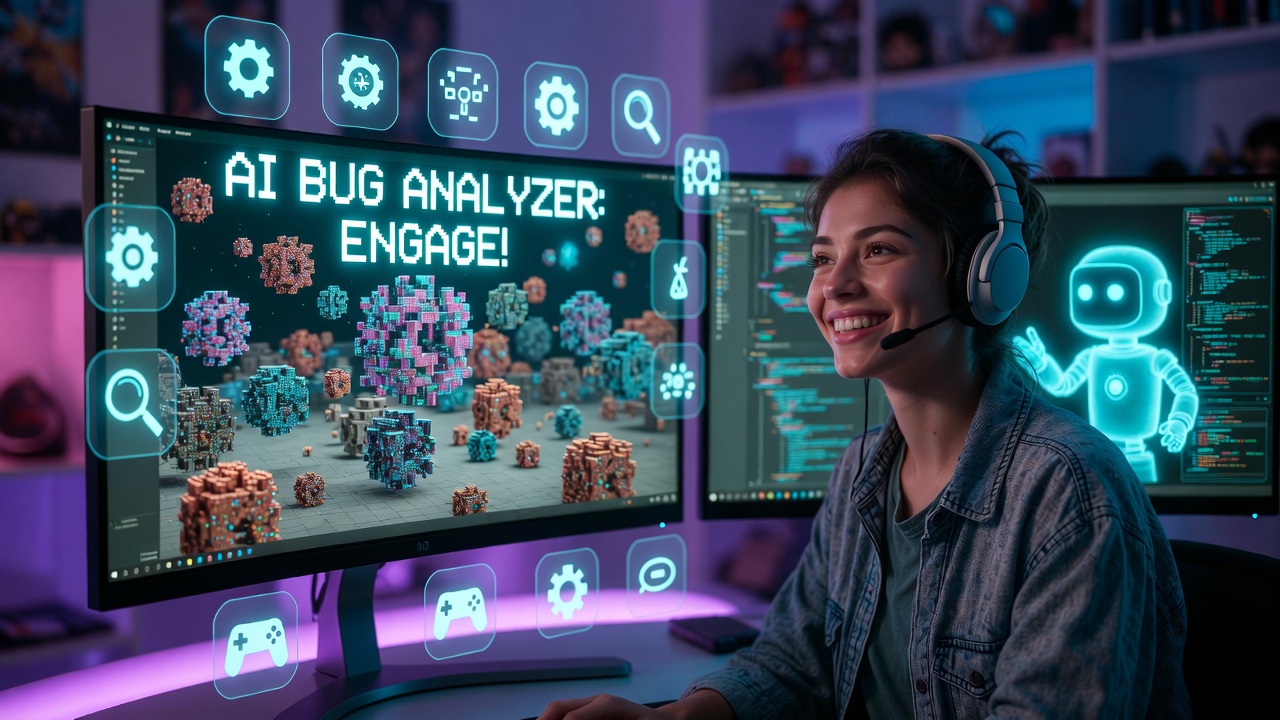
AI in QA Testing: Faster Bugs, Better Games represents one of the most immediate and measurable applications of machine learning in modern game development pipelines. As titles grow in scope—with sprawling open worlds, intricate multiplayer systems, and cross-platform compatibility—the traditional manual QA process struggles to scale. Studios now integrate AI-driven testing to detect issues earlier, reduce regression cycles, and maintain quality without exponentially increasing headcount.
This shift does not eliminate human testers but reframes their role toward exploratory, edge-case, and subjective evaluation while AI handles repetitive, data-intensive tasks. The result is faster iteration and, ultimately, better games delivered to players.
Why Traditional QA Struggles at Scale
Modern AAA and live-service games feature millions of possible state combinations. A single open-world title might include thousands of interactable objects, dynamic weather systems, procedural elements, and player-driven economy simulations. Manual testing covers only a fraction of these paths, often missing subtle regressions introduced by patches or new features.
Common pain points include:
- Regression bugs that reappear after fixes due to incomplete test coverage.
- Performance degradation over long play sessions that human testers rarely replicate fully.
- Multiplayer synchronization issues emerging only under specific network conditions or player counts.
- Localization and accessibility edge cases that multiply with each supported language or platform.
AI in QA Testing: Faster Bugs, Better Games addresses these by automating coverage in ways impossible manually.
Core AI Techniques in Game QA
Several approaches have matured by 2026, each suited to different testing needs.
1. Scripted Bot Testing with Reinforcement Learning
Bots trained via reinforcement learning (RL) explore environments autonomously, seeking to maximize rewards like reaching new areas, completing objectives, or triggering events. Tools like Unity ML-Agents and custom Unreal integrations allow studios to deploy hundreds of parallel bot instances during nightly builds.
- Strengths: High coverage of navigation, physics interactions, and basic progression bugs. Bots often discover crashes or soft-locks in minutes that would take human testers hours.
- Limitations: RL agents can develop exploitative behaviors (e.g., repeatedly jumping in one spot to farm rewards), requiring careful reward shaping. They also struggle with intentional design “breaks” like hidden collectibles.
2. Visual Regression and Anomaly Detection
Computer vision models compare rendered frames across builds to flag visual artifacts, lighting shifts, texture popping, or UI misalignments. Convolutional neural networks (CNNs) trained on clean vs. buggy screenshots detect differences imperceptible to pixel-diff tools.
Popular implementations include open-source projects like perceptual image differencing combined with fine-tuned models from Hugging Face.
3. Log Analysis and Predictive Bug Triaging
Natural language processing (NLP) models parse crash logs, telemetry data, and player reports to cluster similar issues and predict severity. This prioritizes fixes before they reach wide release.
For example, models can flag spikes in “out-of-memory” errors correlated with specific map zones or player actions.
4. Fuzz Testing for Procedural Systems
AI fuzzers generate random but structured inputs (e.g., malformed network packets, extreme player stats, or rapid state changes) to stress procedural generation, AI behaviors, and simulation layers.
Practical Examples from Recent Titles
Several shipped games demonstrate real impact:
- A major open-world RPG used RL bots to simulate 10,000+ hours of continuous play per build cycle, catching physics exploits and quest-breaking state corruptions that manual QA missed in prior titles.
- A live-service shooter integrated vision-based testing to ensure consistent visual quality across 15+ weapon skins and environment variants, reducing post-launch hotfixes by approximately 40% for cosmetic issues.
- An indie procedural roguelike employed log-clustering AI to automatically group thousands of daily player crash reports, cutting triage time from days to hours.
Strengths and Limitations in 2026
| Aspect | Strengths | Limitations | Realistic Impact (2026 Studios) |
|---|---|---|---|
| Coverage | 10x–100x more state exploration than manual | May miss context-aware or narrative bugs | Essential for large-scale titles |
| Speed | Results in hours instead of weeks | Training/setup time for RL agents (days–weeks) | Reduces regression cycles by 50–70% |
| Cost | Lower long-term than expanding QA teams | Upfront compute and engineering investment | ROI within 6–12 months for mid+ studios |
| Accuracy | Excellent for repeatable crashes/performance | False positives in anomaly detection | Human review still required for 20–30% of flags |
| Creativity | Discovers unintended exploits | Cannot evaluate “fun” or subjective polish | Complements, does not replace human judgment |
This table illustrates why AI in QA Testing: Faster Bugs, Better Games succeeds most when treated as a force multiplier rather than a full replacement.
Implementation Best Practices
- Start small: Pilot one technique (e.g., bot exploration in a single level) before scaling.
- Integrate early: Run AI tests in CI/CD pipelines to catch issues pre-merge.
- Combine with human oversight: Use AI flags to guide focused manual sessions.
- Monitor drift: Retrain models as game features evolve to avoid outdated detections.
- Track metrics: Measure bugs found per build, false positive rate, and time-to-resolution.
FAQ
Q: Will AI in QA Testing eliminate QA jobs? A: No. It shifts QA toward higher-value tasks like exploratory testing, accessibility audits, and play-feel evaluation. Studios report needing skilled testers who understand both game systems and AI outputs.
Q: How much compute is required for effective AI QA? A: For RL bot fleets, 10–50 GPUs for training and inference during builds is common for mid-sized studios. Cloud bursting (e.g., AWS GameLift or Azure) makes this accessible without permanent hardware.
Q: Can small teams or indies use these techniques? A: Yes. Open-source tools like Unity ML-Agents, Godot add-ons, and pre-trained models lower the barrier. Many indies start with visual regression scripts before advancing to RL.
Q: Do players notice fewer bugs in AI-tested games? A: Indirectly, yes. Faster cycles mean more polish time, and fewer regressions reach live builds, improving perceived stability.
Q: What about ethical concerns like crunch from faster iteration? A: AI QA can reduce crunch by catching issues earlier, but studios must pair it with healthy production practices.
Key Takeaways
- AI in QA Testing: Faster Bugs, Better Games delivers concrete gains in coverage, speed, and regression prevention.
- Techniques like RL bots, visual anomaly detection, and log analysis complement rather than replace human expertise.
- Successful adoption requires upfront investment, iterative refinement, and integration into existing pipelines.
- Studios that implement AI QA thoughtfully see reduced post-launch fixes and higher player satisfaction.
For related reading on 24-Players.com, explore AI Tools That Actually Save Time in Game Development, Building an AI Tool Stack for Modern Game Development, and The Hidden Costs of AI Tools in Game Production.
External resources for deeper context include the Unity ML-Agents documentation, GDC Vault talks on AI testing pipelines, NVIDIA’s developer resources on game AI, and research papers on reinforcement learning for automated game testing from DeepMind and OpenAI.
As game complexity continues to grow, AI in QA Testing: Faster Bugs, Better Games will evolve from an optimization to a baseline expectation. The studios that master this integration today will set the standard for reliable, high-quality releases tomorrow—paving the way for worlds that feel alive, stable, and truly immersive.
Leave a Reply