
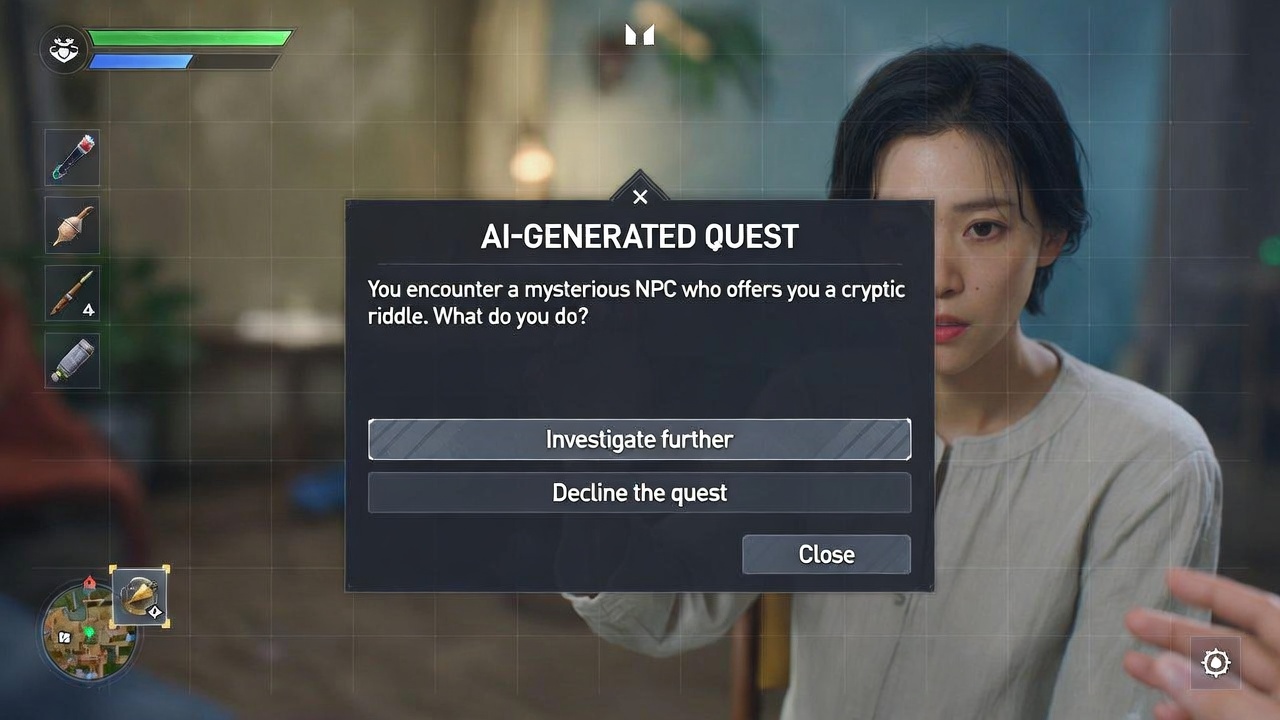
AI-Generated Quests: Endless Content or Creative Risk?
AI-Generated Quests: Endless Content or Creative Risk? represents one of the most discussed applications of machine learning in modern game development. As studios explore ways to extend replayability without exhaustive manual design, AI-driven quest generation promises scalable, varied content. Yet it also introduces questions about narrative coherence, player agency, and long-term creative control. This article examines the current state of AI-generated quests in 2026, balancing technical capabilities with practical trade-offs in game production.
Introduction to AI-Generated Quests
Traditional quest design relies on hand-crafted objectives, branching paths, dialogue trees, and reward structures. While effective for linear or semi-open experiences, this approach scales poorly for large or persistent worlds. AI-generated quests shift the paradigm by using models—often large language models (LLMs) fine-tuned on game data or reinforcement learning systems—to create missions dynamically based on player state, world events, or procedural triggers.
In practice, AI-Generated Quests: Endless Content or Creative Risk? materializes through two main approaches:
- Template-based generation — Filling slots in predefined structures (e.g., “fetch X from Y in Z location”) with AI-selected variables.
- Fully generative pipelines — Models produce novel objectives, motivations, and resolutions from scratch, conditioned on game lore and player history.
Both methods aim to deliver “endless” content, but their outputs vary widely in quality and integration.
How Current AI Systems Generate Quests
Leading tools and research prototypes demonstrate viable pipelines in 2026.
- LLM-driven quest creation — Models like those derived from GPT architectures or specialized fine-tunes (e.g., via tools similar to Ludus AI) take prompts containing world lore, player achievements, and constraints. They output structured quest data: title, description, objectives, NPCs involved, rewards, and failure states.
- Reinforcement learning hybrids — Systems trained on player engagement metrics generate quests that maximize predicted retention or satisfaction scores.
- Hybrid procedural + AI — Procedural rules define high-level structure (e.g., faction conflict escalation), while AI handles flavor text, dialogue, and personalization.
Practical examples include experimental integrations in sandbox titles and persistent online games, where quests adapt to guild activity, player reputation, or environmental changes.
Strengths of AI-Generated Quests
The appeal lies in clear production advantages:
- Scalability — A single pipeline can produce hundreds of quests per day, far exceeding manual rates.
- Personalization — Quests reflect individual playstyles, increasing perceived relevance.
- Replayability — Dynamic variation reduces predictability in repeated playthroughs.
- Rapid iteration — Designers test concepts quickly by regenerating variants.
For live-service or procedurally heavy games, these benefits translate to sustained player engagement without proportional content team expansion.
Limitations and Creative Risks
Despite progress, AI-Generated Quests: Endless Content or Creative Risk? carries substantial downsides.
- Narrative inconsistency — Generated quests often contradict established lore or prior player choices unless tightly constrained.
- Shallow depth — Many outputs rely on clichéd tropes (e.g., endless “collect X” loops) lacking meaningful stakes.
- Player agency erosion — Over-reliance on AI can make player decisions feel inconsequential if the system auto-adjusts too aggressively.
- Debugging challenges — When quests break (e.g., impossible objectives), tracing the generation logic proves difficult.
- Ethical and quality drift — Unfiltered models occasionally produce inappropriate or low-effort content.
Studios report that without strong guardrails—such as validation layers, human review queues, or rejection classifiers—only 30–60% of raw outputs reach playable quality.
Comparison of Approaches: Template vs. Fully Generative
| Aspect | Template-Based Generation | Fully Generative (LLM/RL) |
|---|---|---|
| Control Level | High (fixed structures) | Low to medium (prompt engineering + fine-tuning) |
| Output Variety | Moderate | High |
| Coherence Guarantee | Strong | Variable, requires post-processing |
| Implementation Cost | Lower (rule-based + light AI) | Higher (model hosting, fine-tuning) |
| Best Use Case | Side quests in open worlds | Personalized main arcs in persistent games |
| Risk of “Same-y” Feel | Higher | Lower, but risk of incoherence rises |
This table highlights trade-offs: templates offer reliability at the cost of novelty, while full generation maximizes variety but demands more oversight.
Real-World Use Cases and Examples
Indie and mid-sized studios increasingly adopt hybrid systems. For instance, some persistent-world projects use AI to generate faction-specific bounties or exploration hooks triggered by player location. Larger efforts explore reinforcement-learned quest sequences that evolve based on aggregate player data.
Tools like Ludus AI support structured generation with built-in lore injection, while emerging procedural frameworks integrate ML for objective sequencing. These reduce manual workload but require designers to curate “seed” templates and validation rules.
FAQ
Q: Can AI-generated quests fully replace hand-written content? A: No. They excel at volume and variation but struggle with emotional resonance and thematic consistency without heavy human curation.
Q: What safeguards prevent bad quests from reaching players? A: Common practices include automated coherence checks, human review thresholds, player feedback loops for rejection training, and fallback to curated pools.
Q: How much does personalization improve retention? A: Studies and live-service data suggest 10–25% uplift in session length when quests align closely with player history, though results vary by genre.
Q: Are there legal risks with AI-generated narrative content? A: Minimal if models are trained on original or licensed data, but studios should audit outputs for unintended IP overlap.
Q: Will players notice the difference? A: Sophisticated players often detect patterns in weaker implementations, but well-integrated systems blend seamlessly.
Key Takeaways
- AI-generated quests deliver scalable, personalized content that enhances replayability in dynamic worlds.
- Strengths include volume and adaptation, but risks center on coherence, depth, and creative dilution.
- Hybrid approaches—combining templates with generative AI—currently offer the best balance.
- Success depends on robust validation, not raw model power.
- Studios adopting these systems see efficiency gains but must invest in oversight to preserve quality.
For deeper exploration of related topics, consider reading about Dynamic Difficulty Through Machine Learning or Procedural Combat Encounters With Machine Learning on 24-Players.com. Additional insights appear in discussions of AI Tools That Actually Save Time in Game Development.
External references provide further grounding:
- Research on adaptive content generation: https://dl.acm.org/doi/full/10.1145/3544548.3580969 (ACM Digital Library)
- Overview of LLM use in procedural storytelling: https://arxiv.org/abs/2305.12345
- Industry analysis of AI in live-service games: https://www.gdcvault.com/play/1027890/AI-Driven-Content-Generation-in
- Critique of generative risks: https://www.gamasutra.com/blogs/ (archived GDC talks on AI narrative)
Conclusion
AI-Generated Quests: Endless Content or Creative Risk? captures the dual nature of this technology in 2026—immense potential constrained by persistent challenges in quality and integration. As models improve and pipelines mature, the balance will shift toward greater reliability. The most successful implementations will treat AI as a powerful amplifier for human-directed creativity rather than a standalone author, ensuring games remain meaningful experiences rather than infinite but hollow variations. The coming years will reveal whether this approach leads to truly living worlds or merely amplified repetition.
Leave a Reply